Air Purifier Comparison 2026: LG PuriCare vs Samsung Bespoke vs Coway vs Dyson vs Xiaomi
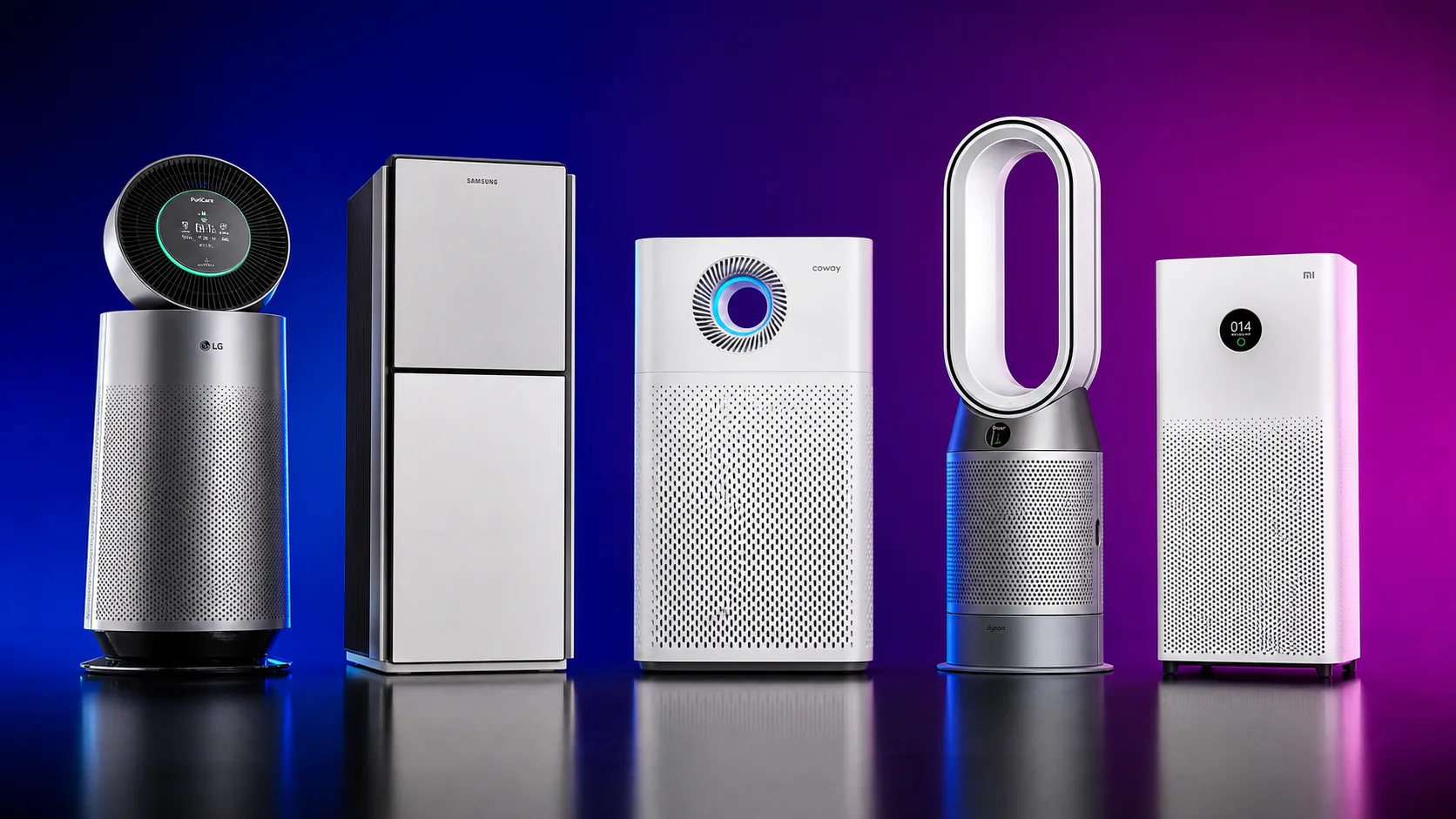
As of August 2026, indoor air quality has become a year-round concern rather than a seasonal one. Even in summer, when fine-dust alerts ease up, running the air conditioner in a sealed room can leave indoor air feeling stale, and harmful gases like formaldehyde off-gassing from new furniture and finishing materials don’t care what season it is. Against that backdrop, this air purifier comparison covers five major brands — LG PuriCare, Samsung Bespoke Cube, Coway Noble, Dyson Purifier, and Xiaomi Smart Air Purifier — built not on marketing copy but on the actual numbers listed on official product pages and price sheets.
According to the monthly big-data brand reputation index published by the Korea Corporate Reputation Research Institute (a Korean brand-analytics firm), Samsung ranked first as of July 2026, followed by LG in second, Dyson in third, and Coway in fourth, with Samsung’s score up 9.65% month over month. It’s worth flagging up front that this ranking is based on online engagement and buzz, not actual unit sales or revenue, so “the brand people talk about most” isn’t necessarily “the brand that sells the most.” What actually drives a purchase decision is a different set of factors entirely: price relative to coverage area, HEPA filter grade and the annual maintenance cost tied to the replacement cycle, and noise and electricity cost in sleep mode.
A story from the second half of 2026 made these maintenance-cost calculations even more important. According to a report from July 28, 2026, 16 of 20 aftermarket (non-genuine) filters tested on the Korean market failed to meet the standard for removing harmful gases, and 12 of them captured less than 90% of the fine dust their labels claimed. That same May, Incheon International Airport Customs busted a smuggling and repackaging ring moving roughly 69,000 counterfeit Chinese filters worth an estimated 7 billion won (about $5 million), some of which tested positive for banned substances. So every “annual filter cost” cited in this article assumes genuine filters — trying to save money with cheap aftermarket ones is a health risk waiting to happen.
What follows covers, in order: a comprehensive comparison table of all five brands, a feature deep-dive on each product, a noise and price benchmark, a complete pricing and maintenance-cost breakdown, recommendations by user type, practical tips and common mistakes, and an FAQ. Wherever a figure couldn’t be verified against official sources, it’s flagged as “unverified” rather than forced in as a guess, so you can trust every number here at face value.
1. Executive Summary: All Five Air Purifiers at a Glance
For readers short on time, here’s every essential detail on all five brands as of August 2026, compressed into a single table. Keep in mind that each product is benchmarked against a different model with its own coverage area and price point, so this isn’t an apples-to-apples comparison of identically sized units.
Note: pyeong is a common Korean floor-area unit (1 pyeong ≈ 3.3 m²) used throughout this article alongside metric conversions; USD figures are approximate, calculated at roughly ₩1,400 = $1.
📊 August 2026 Comprehensive Comparison: All 5 Air Purifiers
| Category | LG PuriCare | Samsung Bespoke Cube Air | Coway Noble | Dyson Purifier | Xiaomi Smart Air Purifier |
|---|---|---|---|---|---|
| Core design philosophy | Cylindrical circulating airflow + AI pollutant detection, doubles as a heater | Cube design + a semi-permanent washable filter that cuts long-term running costs | Subscription-style rental with included in-home servicing | Bladeless airflow + a formaldehyde-specific filter | Rock-bottom price for the coverage area, built around value |
| Latest lineup (Aug. 2026) | PuriCare Objet Collection AI+ 360˚ / AeroTower Hit FS065PSKA | Bespoke Cube™ Air Infinite Line AX033DB900UGD | Noble Air Purifier 2 AP-2023K (20-pyeong class) | Purifier Cool Formaldehyde / Humidify+Cool Cryptomic | Smart Air Purifier 4 / 4 Pro (AC-M15-SC) / 4 Compact |
| Coverage area (as tested) | 18.4 m² (AeroTower Hit) / 62 m² (360˚ Hit) | 33 m² (AX033) | 67 m² (20-pyeong class, AP-2023K) | Official Korean figure unverified (overseas HushJet spec: ~19 m²) | 35-60 m² (4 Pro) |
| Price range | ₩899,000-1,265,000 (~$640-$900), FS065PSKA street-to-list, purchase | ₩589,000-799,000 (~$420-$570), AX033 street-to-list, purchase | ₩27,800-46,700/month (~$20-$33), rental | ₩674,000-1,098,000 (~$480-$780), purchase | ₩248,000-348,000 (~$180-$250), purchase |
| Filter grade | Grade 3 V filter (AeroTower) / HEPA (360˚ line) | S filter (grade undisclosed) | H13 HEPA | Combined HEPA + activated carbon (no individual replacement) | HEPA equipped (H13 certification unverified) |
| Noise (lowest / sleep mode) | 23-26dB (360˚ Hit) | 18dB (model unspecified, reference figure) | Official figure unverified | 24dB (sleep mode, overseas HushJet spec) | 33.7dB (sleep mode, 4 Pro) |
| Annual filter replacement cost | ₩40,000-80,000 (~$30-$60) | Whole-set replacement (high per-swap cost, exact won figure unverified) | |||
| Strengths | Detects 9 pollutant types via AI, doubles as a space heater, ultra-low power in low-speed mode | Semi-permanent washable filter, ultra-low 15W power draw | No big upfront cost thanks to rental, confirmed H13 grade | Sleek design, a shared spec of removing 99.97% of 0.3-micron particles | Best value with a 500 m³/h CADR (4 Pro) |
| Weaknesses | Flagship models run pricey, some details on newer models still unconfirmed | No official confirmation of a 2026 refresh | Total rental cost can exceed the purchase price after 3+ years | Hard to verify exact CADR and Korean noise figures, filter replacement cost adds up | Sleep-mode noise is relatively loud, HEPA grade certification unclear |
| Best for | Households wanting a heater/purifier combo, early adopters of new tech | 1-3 person households wanting low power draw and minimal long-term upkeep | Rental-minded households who want in-home servicing without a big upfront cost | Households that value design and brand experience and have room in the budget | Value-focused households wanting to cover a large space cheaply |
The two rows worth studying most closely here are filter grade and annual filter cost. It’s easy to assume that any product labeled “HEPA” is the same grade, but H13 certification is officially confirmed only for the Coway Noble 2 and Samsung’s 30-pyeong rental model (AX100DB900UDD) — every other line, including Samsung’s own AX033, plus Dyson and Xiaomi, either doesn’t disclose the grade clearly or it simply couldn’t be verified. Dyson is also a clear outlier among the five: because its HEPA and deodorizing filters are fused into a single unit, saturating either one means replacing the entire set. The price-range row also deserves a caveat: LG’s and Samsung’s ranges span list price to street price on the same model, while Dyson’s and Xiaomi’s ranges compare street prices across different models, so the two aren’t calculated on the same basis.
2. Feature Deep-Dive: What Each Air Purifier Actually Does
🌀 1) LG PuriCare — AI Pollutant Detection Meets a Built-In Heater
- The new AI+ 360˚ model’s headline feature is broader detection range: The LG PuriCare Objet Collection AI+ 360˚ is the first LG air purifier to include an “AI air-quality sensor,” able to detect nine types of pollutants including formaldehyde, ammonia, and oil vapor. That said, this research couldn’t pin down an exact launch date or model code from an original press release — the information is confirmed only through articles citing it secondhand, so treat those specifics with a little caution.
- Street price on the perennial best-seller, the AeroTower Hit: The FS065PSKA lists at ₩1,265,000 (
$900) but sells for ₩899,000 ($640) in practice; the FS065PSJC lists at ₩1,209,000 ($860) and sells for ₩1,090,000 ($780). Both cover 18.4 m² (about 5.6 pyeong), draw 1,500W when running as a heater, carry an energy-efficiency grade of 3, and include a PM1.0 sensor and UV fan sterilization. - The 360˚ Hit, rated for 62 m²: A separate line built around a cylindrical 360˚ HEPA filter, with noise in the 23-26dB range. Official list price couldn’t be confirmed, but comparison outlets peg it at roughly ₩360,000 (~$260).
- Filter upkeep and electricity cost: A genuine filter set (HEPA + deodorizing) runs ₩40,000-80,000 (
$30-$60) depending on the model, with the HEPA element swapped roughly every 12 months and the deodorizing filter every 6 months. Some units draw as little as about 7W in low-speed/auto mode, which comparison outlets estimate works out to a monthly electricity bill of only around ₩756 ($0.54). - New tech unveiled in August 2026: At “Air Fair 2026,” held at COEX (a major convention center in Seoul), LG showed off a new MOF (metal-organic framework) filter material, though when it will actually ship in a product remains unconfirmed. This rapid spread of AI-based detection into home appliances tracks the same trend covered in our ChatGPT, Claude, Gemini, and other AI model comparison.
🧊 2) Samsung Bespoke Cube Air — Low Power Meets a Semi-Permanent Filter
- The Infinite Line is still the flagship: The most current confirmed model on sale is the Bespoke Cube™ Air Infinite Line AX033DB900UGD (10-pyeong class, 33 m²), sold alongside the higher-tier AX100DB900UDD, which covers the larger 30-pyeong bracket. No separate official announcement of a 2026-model refresh turned up in this research.
- AX033 spec sheet: Coverage of 10 pyeong (33 m²), a CADR of 55 m³/h, a mere 15W power draw, energy-efficiency grade 1, dimensions of 320×545×320mm, and an S-filter setup. It packs PM1.0, gas, light, and pet-detection sensors, plus “4-way surround purification + powerful deodorizing” and a Custom Clean AI+ feature.
- List price and street price diverge quite a bit: The AX033DB900UGD lists at ₩799,000 (
$570), but its lowest street price drops to ₩589,140 ($420). The higher-tier 100 m² Infinite Line model, meanwhile, runs roughly ₩1,370,000 (~$980) according to comparison outlets. - A semi-permanent washable filter is the key differentiator: The 100 m² Infinite Line adds a CADR of 120 m³, UV sterilization, and removal of ultrafine dust, odors, and harmful gases on top of a semi-permanent washable filter — a design choice aimed at cutting down on recurring replacement costs. That said, a separate figure surfaces for the 30-pyeong rental model (AX100DB900UDD): H13 HEPA, a 6-month replacement cycle, and an annual filter cost of about ₩120,000 (~$85) — worth noting that’s a different SKU than the AX033 discussed above.
- Noise is a reference figure, not a guarantee: Comparison outlets cite a minimum noise level of 18dB, but which exact model that figure refers to isn’t specified.
🛎️ 3) Coway Noble — A Subscription Air Purifier Built Around Rental
- The flagship model is the Noble Air Purifier 2: The most current confirmed model is the Noble Air Purifier 2 (AP-2023K), a 20-pyeong (67 m²) class unit, sold alongside an older large-capacity line (100 m², model code unconfirmed) and a smaller Noble 2 (53 m²). The code name “AP-2024,” which circulates online, didn’t turn up anywhere in this research and appears to be a model that doesn’t actually exist — worth noting so you don’t get confused while shopping.
- Rental is the primary sales channel: Pricing starts at ₩27,810/month (
$20) for the 16-pyeong ($33) for the 35-pyeong (53 m²) model, ₩33,900/month ($24) for the 20-pyeong AP-2023K, ₩45,900/month (116 m²) model, and ₩46,710/month ($33) for the 40-pyeong (~132 m²) model. The one-time purchase price couldn’t be confirmed in this research because the official page failed to load. - One of the few brands with confirmed H13 certification: The AP-2023K (20-pyeong) has officially confirmed H13 HEPA grading, a 6-month filter replacement cycle, and an annual filter cost of about ₩91,000 (~$65). Pet-specific features and a “choose from 6 filter types” setup round out its spec sheet.
- CADR and noise: unverified: The official product page kept returning a skeleton (failed-to-load) state, so this research couldn’t pin down exact CADR or noise (dB) figures. Rather than guess, it’s more accurate to leave this as “unable to officially confirm.”
- The catch with renting: Coway’s rental plan bundles in filter swaps and in-home servicing, but comparison outlets consistently flag the same issue: once you’re past three years, total rental payments can exceed what you’d have paid to buy the unit outright. For reference — not a Korean price, this is Coway’s U.S. operation — the Noble Air rents for $39.99/month and up in the U.S.
🌪️ 4) Dyson Purifier — Bladeless Airflow, Premium Design
- Three models sold in Korea: The Dyson Purifier Cool Formaldehyde, the Dyson Purifier Humidify+Cool Formaldehyde (which doubles as a humidifier), and the Dyson Pure Humidify+Cool Cryptomic are all currently sold through dyson.co.kr.
- A lineup expansion announced in January 2026: Alongside a robot vacuum and a mopping robot, Dyson unveiled its first compact air purifier for the Korean market at a pop-up at The Hyundai Seoul department store on January 22. Reports describe a 360-degree electrostatic capture method and a formaldehyde filter, with a claimed 99.97% removal rate for 0.3-micron particles. The reported price of ₩499,000 (~$360), however, was somewhat ambiguous in context about which exact model it applied to, so this research couldn’t confirm the price-to-model match.
- Whether the global HushJet has launched in Korea is unconfirmed: The Dyson HushJet™ Purifier Compact, an ultra-compact model launched globally in 2026, sells for $349.99 in the U.S. (around $297 in practice on Amazon), but this research couldn’t confirm whether it has officially launched in Korea or what it would cost there. No Korean-language press release turned up — only English-language reviews.
- Prices span a wide range: Across retail channels like Danawa (a Korean price-comparison shopping site) and SSG.com (a major Korean online mall), the Dyson Purifier Cool (PC2 series) runs ₩674,000 (
$480), the Purifier Big+Quiet (BP02) runs ₩913,000 ($650), and the Big+Quiet Formaldehyde (BP03) runs ₩1,098,000 (~$780). Every model in the lineup shares the same spec of removing 99.97% of 0.3-micron ultrafine particles. - Filter architecture is the deciding factor on running costs: Dyson fuses the HEPA and activated-carbon (deodorizing) filters into a single unit, meaning no individual replacement is possible. Saturate just the HEPA layer and you still have to replace the whole set, so while replacements happen less often, each one costs more. On the HushJet, sleep-mode noise is rated at 24dB, the manufacturer claims filter life 5x longer than before, and it includes a 360˚ activated-carbon gas-and-odor filter. This research couldn’t confirm the exact CADR or Korean certification grade (H13 or not) for the models sold in Korea, since the official product pages kept returning an access error (403).
🧭 5) Xiaomi Smart Air Purifier — Cheap Coverage for Large Rooms
- Three officially imported models in Korea: The Xiaomi Smart Air Purifier 4 (standard), the compact 4 Compact rated for 4-8 pyeong (~13-26 m²), and the 4 Pro (model AC-M15-SC), which covers 10.5-18 pyeong (35-60 m²), are all officially sold through mi.com/kr. IT distributor Daewon CTS holds the official partnership agreement with Xiaomi in Korea and distributes the units through 11st (a major Korean e-commerce marketplace), SSG.com, and Olive Young (a Korean health-and-beauty retail chain).
- Among the cheapest of all five brands: The Smart Air Purifier 4 (standard) runs ₩248,000 (
$180) on 11st, while the 4 Pro (AC-M15-SC) hits a Danawa low price of ₩348,000 ($250). The exact won price for the 4 Compact couldn’t be confirmed, but globally (in the U.S.) the Smart Air Purifier 4 Compact sells for $268.99. - The 4 Pro’s CADR is the highest confirmed figure of any brand here: A 500 m³/h CADR, coverage of 10.5-18 pyeong (35-60 m²), 50W power draw, 6.8kg weight, dimensions of 275×680×275mm, and an energy-efficiency grade of 3.
- Sleep-mode noise runs relatively high: The 4 Pro’s sleep-mode noise is 33.7dB(A), somewhat louder than the sleep-mode figures confirmed for other brands in this comparison (LG at 23-26dB, Dyson at 24dB). It carries a HEPA filter and the same 99.97% removal rate for 0.3μm particles, but whether it’s specifically H13-certified couldn’t be confirmed.
- Possibly the cheapest filters to maintain: One brand-comparison article cites an annual filter cost of ₩28,900 (~$21) and calls Xiaomi “the cheapest brand,” but since no specific model is named, treat this as a reference figure only. It also supports remote control via the Mi Home/Xiaomi Home app and a laser-sensor-based auto mode.
3. Noise & Running-Cost Benchmark: Head-to-Head
In any real-world air purifier comparison, the two things people notice most are sleep-mode noise and annual running cost. That said, this research couldn’t pin down Coway’s official CADR and noise figures, Dyson’s exact CADR and certification grade for the Korean market, or which specific model Samsung’s noise figure applies to. Rather than force in unverified numbers, the ranking below uses only confirmed figures.
[Lowest sleep-mode noise, August 2026 — officially confirmed figures only]
Samsung Bespoke Cube (18dB, model unspecified, reference)  : ⭐⭐⭐⭐⭐ Feels close to silent in practice
LG PuriCare 360˚ Hit (23-26dB)                             : ⭐⭐⭐⭐☆ Perfectly fine for bedroom use
Dyson Purifier HushJet (24dB, overseas spec)               : ⭐⭐⭐⭐☆ Official Korea launch status needs separate confirmation
Xiaomi Smart Air Purifier 4 Pro (33.7dB)                   : ⭐⭐⭐☆☆ A bit loud for "sleep mode"
Coway Noble series                                          : ❔ Official page inaccessible, noise figure unverified
Once you look at price and coverage together, the price per square meter varies widely even within the same brand’s lineup. The table below is our own calculation, limited to models where both price and coverage area were confirmed, and it isn’t meant as an absolute apples-to-apples comparison across different brands and sizes.
| Model | Price | Coverage area | Price per m² (reference calc) |
|---|---|---|---|
| LG AeroTower Hit (FS065PSKA) | ₩899,000 (~$640) | 18.4 m² | |
| LG PuriCare 360˚ Hit | 62 m² | ||
| Samsung Bespoke Cube AX033DB900UGD | ₩589,140 (~$420) | 33 m² | |
| Xiaomi Smart Air Purifier 4 Pro | ₩348,000 (~$250) | 35-60 m² |
Judging by this table alone, the LG 360˚ Hit and Xiaomi 4 Pro look like the best deals per square meter, but that only accounts for the upfront purchase price. Once you fold in annual filter costs (₩40,000-80,000 for LG, ~₩120,000 for Samsung [based on the 30-pyeong AX100 rental model, a different SKU than the AX033 in the table above], ~₩91,000 for Coway, ~₩28,900 as a reference figure for Xiaomi, and a higher per-swap cost for Dyson thanks to its whole-set replacement design) and look at total cost of ownership (TCO) over several years, the rankings can shift. And for a rental product like Coway, this upfront-purchase-price math doesn’t even apply in the first place.
4. Full Pricing Comparison
[Lowest upfront cost first — list/street price, rentals shown separately]
Xiaomi Smart Air Purifier 4 (standard)          : ₩248,000 (~$180)
Xiaomi Smart Air Purifier 4 Pro                 : ₩348,000 (~$250)
Coway Noble 2 AP-2023K (rental)                 : ₩33,900/mo+ (~$24; purchase price unverified)
Samsung Bespoke Cube AX033 (lowest street price): ₩589,140 (~$420)
Dyson Purifier Cool (PC2 series)                : ₩674,000 (~$480)
LG AeroTower Hit FS065PSKA (street price)       : ₩899,000 (~$640)
Dyson Purifier Big+Quiet Formaldehyde (BP03)    : ₩1,098,000 (~$780)
💰 Detailed Price & Running-Cost Comparison
| Brand | Flagship model | Purchase price | Rental (if offered) | Annual filter cost | Filter subscription option |
|---|---|---|---|---|---|
| LG PuriCare | AeroTower Hit FS065PSKA | ₩899,000 (~$640, street) | None | ₩40,000-80,000 (~$30-$60) | 6-year plan, ₩24,400-26,400/mo (~$17-$19) |
| Samsung Bespoke | Cube Air AX033DB900UGD | ₩589,140 (~$420, street) | None (a separate rental product exists for the AX100 line, from ₩37,500/mo, ~$27) | Unverified | |
| Coway | Noble 2 AP-2023K | Unverified | ₩33,900/mo+ (~$24), 20-pyeong | Filter swaps and in-home servicing included in the rental fee | |
| Dyson | Purifier Cool (PC2) | ₩674,000 (~$480) | None | Unverified (whole-set replacement design) | None |
| Xiaomi | Smart Air Purifier 4 Pro | ₩348,000 (~$250) | None | None |
Three hidden-cost points are worth calling out. First, Coway’s rental does bundle in the value of in-home servicing, but comparison outlets consistently note that once you’re past three years, total rental payments can exceed the purchase price. If you’re comfortable swapping filters yourself, buying outright can be the better deal long-term. Second, Dyson’s filter design means fewer replacements but a higher cost per swap. Because the HEPA and deodorizing filters are fused together, saturating just one forces you to buy the whole set again — so don’t assume it’s cheap just by looking at a single filter’s price. Third, trying to cut costs with aftermarket (non-genuine) filters is genuinely risky. As mentioned earlier, a July 2026 investigation found that 16 of 20 aftermarket filters on the market failed to meet the standard for removing harmful gases, and 12 captured less than 90% of the fine dust their labels claimed. Every filter cost cited in this article assumes genuine filters — worth repeating one more time.
5. Final Recommendations by User Type
🎯 1) Households With Infants or Young Children Who Need Gas Detection and Low Noise Above All
- Best pick: LG PuriCare AI+ 360˚ or Samsung Bespoke Cube
- Why: The LG AI+ 360˚‘s strength is detecting nine pollutant types, including formaldehyde and ammonia, while Samsung’s low 18dB noise (reference figure) and 15W power draw make it easy to leave running all night without worry. That said, neither model’s filter grade (LG’s Grade 3 V filter/HEPA, Samsung’s S filter) carries the same official confirmation as H13 — if particle-removal grade is your top priority, the Coway Noble 2 (rental), with its confirmed H13 HEPA, is worth considering too.
🎯 2) Solo Renters in a Studio or Small Space on a Tight Budget
- Best pick: Xiaomi Smart Air Purifier 4 (standard) or 4 Compact
- Why: At ₩248,000 (~$180), it’s the lowest entry price of all five brands, and you get remote control through the Mi Home app. Just factor in its relatively loud sleep-mode noise if you’ll be placing it right next to your bed.
🎯 3) Households Covering 30+ Pyeong (~100 m²) on Low Power
- Best pick: Samsung Bespoke Cube Air Infinite Line (100 m² class)
- Why: Its semi-permanent washable filter is designed to cut down on recurring replacement costs, and with a 120 m³ CADR plus UV sterilization, performance doesn’t drop off even in a large space.
🎯 4) Rental-Minded Households Who Want Regular Servicing Without a Big Upfront Cost
- Best pick: Coway Noble 2 (AP-2023K)
- Why: Rental starting at ₩33,900/month (~$24) means no big upfront outlay, and it’s one of the few products with officially confirmed H13 HEPA certification. If you’re planning to keep it for three-plus years, though, it’s worth running the total-cost numbers ahead of time.
🎯 5) Design-Conscious Households With a Premium Budget Who Also Want Humidifying
- Best pick: Dyson Purifier Humidify+Cool (Formaldehyde / Cryptomic)
- Why: Bladeless airflow and sleek design remain Dyson’s unmatched strengths, and it packs a shared 99.97% removal rate for 0.3-micron particles plus humidifying into one unit. Just budget ahead for the running costs that come with its whole-set filter replacement design.
🎯 6) Households Wanting a Year-Round Heater/Purifier Combo
- Best pick: LG AeroTower Hit
- Why: On top of air purification, it doubles as a 1,500W space heater, making it genuinely useful as a supplemental heat source during the shoulder seasons and winter.
6. Practical Tips & Common Mistakes
✅ Tip 1) Treat 70-80% of the Listed Coverage Area as Your Real-World Usable Range
Multiple comparison outlets flag the same issue: taking a manufacturer’s listed coverage area at face value can leave you under-powered in real-world use. Treat the recommended usable area as 70-80% of the listed figure, and it’s safer to size up to a model rated for a bit more than your actual room.
✅ Tip 2) Never Use Aftermarket (Non-Genuine) Filters
A July 2026 investigation found that 16 of 20 aftermarket filters on the market fell short of the standard for removing harmful gases, and 12 captured less than 90% of the fine dust listed on the label; that same May, Incheon International Airport Customs busted a counterfeit-filter smuggling ring moving roughly 69,000 units, some of which tested positive for banned substances. Even if the filter cost stings, sticking to genuine filters ends up being the cheaper choice overall.
✅ Tip 3) Always Calculate the Total Rental Cost Yourself
For a rental-first product like Coway’s, “only ₩33,900 a month” ($24) sounds cheap on its face, but multiply that by 36 months (3 years) and you’re well past ₩1,000,000 ($720). It’s worth developing the habit of adding up a comparable purchase model’s price plus its annual filter cost over three years and comparing the two directly.
✅ Tip 4) Set Aside a Separate Filter Budget for Dyson
Dyson fuses its HEPA and deodorizing filters into a single unit, so individual replacement isn’t possible. That means even if just one filter saturates, you have to buy the entire set again — so while the replacement interval may be longer than other brands’, build the higher per-swap cost into your budget ahead of time.
✅ Tip 5) Power-Draw Differences Add Up in Your Electricity Bill With Continuous Use
LG’s low-speed (auto) mode reportedly draws as little as about 7W, which one estimate puts at only around ₩756/month (~$0.54) in electricity, while the Xiaomi 4 Pro is confirmed at 50W. If you run your purifier around the clock, this gap in power draw compounds into a noticeable difference in your electricity bill.
✅ Tip 6) Factor In the Hassle of Juggling Multiple Brand Apps
LG ThinQ, Samsung SmartThings, and Mi Home are all separate, brand-specific apps, so if you’ve already standardized your other appliances around one brand’s ecosystem, it’s more convenient to keep your air purifier in that same ecosystem. This same app-fragmentation headache comes up in our Naver Map vs. KakaoMap vs. TMAP vs. Google Maps comparison.
7. Frequently Asked Questions (FAQ)
Q. What should I check first when comparing air purifiers?
The actual size of the space you’ll be using it in, the filter grade (whether it’s H13 or not), and the annual running cost including regular filter replacements. If you decide based purely on the sticker price, you may end up spending more than expected on filters a few years down the line. This air purifier comparison shows exactly that — the ranking by upfront price and the ranking by running cost don’t line up.
Q. Is renting or buying the better deal?
Renting makes sense if you’re planning short-term use (1-2 years) or want to avoid a big upfront outlay. But multiple comparison outlets consistently note that even for a rental-first brand like Coway, total rental payments overtake the one-time purchase price once you’re past three years. If you’re planning to use it for three-plus years, buying outright and handling your own filter swaps is likely the cheaper path overall.
Q. Why does H13 HEPA certification matter?
H13 is a high-performance filter grade under the European standard EN 1822, capturing ultrafine 0.3-micron particles at a very high efficiency. This research found officially confirmed H13 certification only on the Coway Noble 2 (AP-2023K) and Samsung Bespoke Cube Air’s 30-pyeong rental model (AX100DB900UDD) — every other line (including Samsung’s own AX033), plus Dyson and Xiaomi, either doesn’t disclose the grade clearly or it couldn’t be verified. The word “HEPA” alone doesn’t tell you the grade, so it’s safer to check the product detail page yourself before buying.
Q. Why are Dyson’s filter replacement costs relatively steep?
Because the HEPA filter and the activated-carbon (deodorizing) filter are fused into a single set, individual replacement isn’t possible. Other brands let you replace the HEPA and deodorizing filters separately, swapping only whichever one is needed, but with Dyson, saturating either one means buying the entire set new, which drives up the cost of each replacement.
Q. Is it okay to use aftermarket (non-genuine) filters?
Not recommended. A July 2026 investigation found that 16 of 20 aftermarket filters sold on the market failed to meet the standard for removing harmful gases, and 12 captured less than 90% of the fine dust listed on the label. That same May, Incheon International Airport Customs busted a counterfeit-filter smuggling ring moving roughly 69,000 units, some of which tested positive for banned substances. Trying to save on filter costs can end up making your indoor air quality worse.
Q. Why doesn’t this article include exact CADR and noise figures for Coway and Dyson?
During this research, Coway’s official product page kept returning a failed-to-load (skeleton) state, and the individual product pages on Dyson’s official Korean store returned an access error (403). Rather than guessing at unverified numbers, this comparison flags them as “unverified” and sticks only to confirmed information — that’s what makes for an accurate air purifier comparison. Before you actually buy, it’s worth double-checking the latest figures on each brand’s official page.
Q. Does an AI air-quality sensor actually make a meaningful difference?
A feature like LG’s AI+ 360˚, which individually detects nine pollutant types including formaldehyde, ammonia, and oil vapor, does give you a better read on what’s actually causing an air-quality problem than a conventional sensor that only shows a fine-dust concentration number. That said, this research didn’t turn up third-party data quantifying detection accuracy or real-world differences, so it’s safer to treat “it detects more categories” as the main takeaway rather than assume it translates directly into better performance.
Q. What’s the right product for a small studio apartment?
For a studio in the 5-8 pyeong (17-26 m²) range, a compact model like the LG AeroTower Hit (rated for 18.4 m²) or the Xiaomi 4 Compact (4-8 pyeong) is a good fit. The Xiaomi 4 (standard), in particular, is well-suited to budget-conscious students and solo renters thanks to its low ₩248,000 ($180) entry price.
8. Conclusion: The Practical Takeaway From the 2026 Air Purifier Comparison
As of August 2026, the takeaway from this air purifier comparison is that ranking first in brand reputation doesn’t automatically mean a product is the right fit for you. Samsung holds the top spot on the brand reputation index, but that’s purely an online-engagement metric — a different thing entirely from actual sales volume or a performance ranking. From a practical-use standpoint, room size, filter grade, annual running cost, and whether you plan to rent or buy are the variables that actually decide the outcome.
In practice, the right choice splits cleanly by use case. Households with a newborn who prioritize gas detection and low noise are best served by the LG AI+ 360˚ or Samsung Bespoke Cube; those covering a large space on low power should look at Samsung’s Infinite Line; anyone wanting managed service without a big upfront cost should go with Coway Noble; households that want design and humidifying together should pick a Dyson Purifier; and solo renters minimizing budget should go with a Xiaomi Smart Air Purifier — each plays to its own strengths best in these scenarios. Whatever you choose, sticking to two simple rules — replace genuine filters on schedule, and size up one step past the listed coverage area — dramatically cuts your odds of picking wrong. Treating an appliance subscription fee as a recurring monthly expense isn’t so different from the mindset around monthly subscription costs covered in our Google Drive vs. OneDrive vs. iCloud cloud storage comparison.
[Summary: Final pick for your situation]

Household with an infant/toddler, gas detection + low noise are top priority
  → LG PuriCare AI+ 360˚ or Samsung Bespoke Cube (18dB reference figure)

Studio apartment / solo renter, minimizing budget
  → Xiaomi Smart Air Purifier 4 (from ₩248,000, ~$180)

30+ pyeong (~100 m²) space, cutting long-term running costs
  → Samsung Bespoke Cube Air Infinite Line (semi-permanent washable filter, 15W)

Managed service without a big upfront cost
  → Coway Noble 2 AP-2023K (from ₩33,900/mo, ~$24; H13 confirmed)

Design + humidifying combo, premium budget
  → Dyson Purifier Humidify+Cool (budget for whole-set filter replacement)

Year-round heater combo
  → LG AeroTower Hit (doubles as a 1,500W heater)
Settle on your room size, budget, and how you want to handle running costs first, then layer the numbers from this air purifier comparison on top — that’s how you pick the right product without getting swayed by marketing copy.