AWS vs Google Cloud vs Azure vs Naver Cloud vs DigitalOcean: Complete 2026 Cloud Infrastructure Comparison Guide
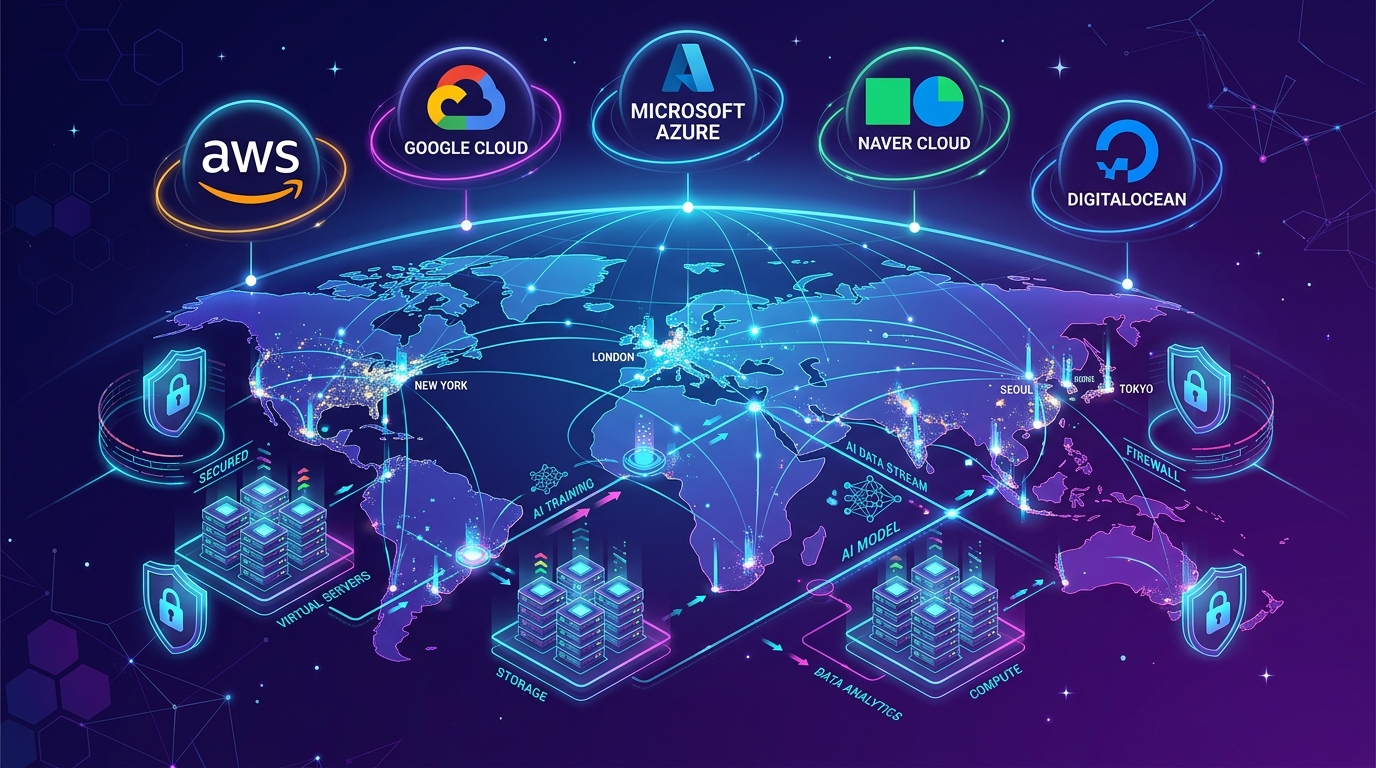
As of July 2026, cloud infrastructure services (Cloud Infrastructure Providers / IaaS & PaaS) serve as the critical backbone for web applications, mobile apps, artificial intelligence (AI) models, and enterprise IT systems. Moving away from the era of managing on-premise servers, how efficiently an organization utilizes cloud infrastructure now dictates its speed of growth and operational agility.
In July 2026, key criteria for selecting a cloud platform revolve around “global network stability and latency, advanced AI/ML agent platforms (Amazon Bedrock, Google Vertex AI, Azure OpenAI, Naver HyperCLOVA X), compliance with Korean public/financial regulations, and predictable transparent pricing with FinOps cost optimization.”
The five major platforms leading today’s cloud ecosystem—AWS (Amazon Web Services), Google Cloud (GCP), Microsoft Azure, Naver Cloud, and DigitalOcean—each offer unique service architectures and pricing models tailored to developers and enterprise organizations.
Based on the latest data and real-world engineering benchmarks as of July 30, 2026, this guide provides an in-depth, comprehensive comparison of the top 5 cloud platforms across virtual server (compute) performance, AI/big data platforms, object storage, network latency in South Korea, pricing models, and optimal recommendations by developer and enterprise type.
1. Executive Summary: The Top 5 Cloud Services at a Glance (July 2026)
For busy engineers and project managers, here is a comprehensive comparison table summarizing the core specifications and key features of the top 5 cloud providers as of July 2026.
📊 Top 5 Cloud Services Comparison Table (July 2026)
| Feature | AWS (Amazon Web Services) | Google Cloud (GCP) | Microsoft Azure | Naver Cloud | DigitalOcean |
|---|---|---|---|---|---|
| Core Architecture Philosophy | Industry #1 Global Standard & Massive Catalog | AI/ML Platform & Big Data Analytics | M365 Integration & Enterprise Hybrid | S. Korea Public/Financial Compliance & Local Support | Ultra-simple Independent VPS & Value Fixed Pricing |
| Key Services | EC2, S3, RDS, Amazon Bedrock | Compute Engine, BigQuery, Vertex AI | Azure VM, Blob, Azure OpenAI Service | VServer, Object Storage, HyperCLOVA X | Droplets, Spaces, Managed Kubernetes |
| AI / ML Ecosystem | Bedrock (Multi-LLM Agent Ecosystem) | Vertex AI (Seamless Gemini 2.0 Integration) | Azure OpenAI Service (GPT-4o) | HyperCLOVA X (Korean-specialized LLM) | AI/ML Dedicated Nodes |
| S. Korea Region & Network | Seoul Region (3+ AZs) | Seoul Region (Low Latency) | Seoul & Korea East Regions | Lowest Domestic Latency & Korean Support | Singapore / US / EU Major Regions |
| Pricing Model | Pay-as-you-go + Reserved Instances (RI) | Pay-as-you-go + Sustained Use Discounts (SUD) | Pay-as-you-go + Reserved Instance Discounts | KRW Pay-as-you-go + Commitment Discounts | Predictable Fixed Monthly Flat-rate Pricing |
| Free Tier / Credits | 12-Month Free Tier | $300 Free Trial Credit for New Users | $200 Free Trial Credit for New Users | 300,000 KRW (30만 원) 3-Month Credit | $200 60-Day Free Trial Credit |
| Best Recommended For | Large-scale Global Services, Infrastructure Standard | Data Analytics, AI Model Dev, K8s Environments | Windows-based Enterprises, MS Hybrid Setup | Domestic S. Korea Public/Financial Institutions, Korean Services | Startups, Solo Developers, Cost-effective VPS |
2. Deep Dive: Key Features of the 5 Major Cloud Providers
The best cloud platform for your team depends on the nature of your application—whether it requires global reach, AI/big data capabilities, Microsoft enterprise synergy, South Korean regulatory compliance, or small-scale cost efficiency.
🌐 1) AWS (Amazon Web Services) - The #1 Global Cloud Standard
- Vast Service Ecosystem: Offers the widest spectrum of services in the industry, ranging from EC2 virtual servers and S3 object storage to Aurora databases and Amazon Bedrock AI services.
- Global Reliability: Operates dozens of regions and Availability Zones (AZs) worldwide, making it the top choice for disaster recovery and seamless global scaling.
🧠 2) Google Cloud (GCP) - Powerhouse for AI, Machine Learning & Big Data
- BigQuery & Vertex AI: Standout capabilities include BigQuery for querying petabytes of data in seconds and Vertex AI for effortlessly fine-tuning Gemini 2.0 models.
- Pioneer of Kubernetes (GKE): Provides the industry’s most robust Google Kubernetes Engine (GKE), built by the original creators of Kubernetes.
🏢 3) Microsoft Azure - Enterprise MS365 & Hybrid Cloud Synergy
- Azure OpenAI Service: Leads enterprise AI adoption by offering OpenAI’s latest GPT models inside enterprise-grade cloud security perimeters.
- Native MS Ecosystem Integration: Seamlessly integrates with Windows Server, Active Directory (Entra ID), and Microsoft 365 environments.
🇰🇷 4) Naver Cloud (NCP) - South Korean Compliance & Lowest Domestic Latency
- Full Domestic Regulatory Compliance: 100% compliant with S. Korea’s CSAP public security certification and financial industry guidelines, making it essential for domestic public and financial projects.
- HyperCLOVA X & Local Support: Features Naver’s native HyperCLOVA X LLM embedded into the infrastructure, optimal for Korean language business automation.
🚀 5) DigitalOcean - The Budget-Friendly Haven for Startups & Solo Developers
- Predictable Fixed Pricing: Run compute instances (Droplets) starting at $4–$10/month without complex bandwidth calculations or bill shock.
- Intuitive User Experience: Deploy infrastructure instantly in just a few clicks without navigating complex IAM permission rules.
3. South Korea Infrastructure Latency & Cost Optimization (FinOps)
[Network Latency in South Korea (Latency, lower is better)]
Naver Cloud (NCP)     :  2 ~ 5 ms   ██                               (Lowest domestic latency!)
AWS Seoul Region      :  5 ~ 10 ms  ███
Google Cloud Seoul    :  5 ~ 10 ms  ███
MS Azure Korea East   :  8 ~ 15 ms  ████
DigitalOcean (SG)     : 40 ~ 70 ms  ██████████████                   (Via overseas region)
💰 FinOps Cost Reduction & Pricing Tips
- AWS & Azure: Save up to 70%+ on compute costs by leveraging 1-year or 3-year Reserved Instances (RI) or Savings Plans.
- GCP: Sustained Use Discounts (SUD) apply automatically as instances run longer, rewarding steady workloads with built-in savings.
- DigitalOcean: The most cost-effective platform for smaller services, eliminating budget uncertainty and bill shock.
4. Final Recommendation Guide by User & Organization Type
Based on the analysis above, here is the decision matrix for “Which cloud platform should our team choose?”
🎯 1) Large-scale Services Targeting Global Markets with Proven Infrastructure Standards
- Top Choice: AWS (Amazon Web Services)
- Why: Offers the broadest array of cloud products, unmatched global talent availability, and industry-standard architecture support.
🎯 2) Teams Building Big Data Analytics Pipelines & Gemini-based AI Applications
- Top Choice: Google Cloud (GCP)
- Why: Delivers superior data analytics and AI/ML capabilities powered by BigQuery and Vertex AI.
🎯 3) Enterprises Utilizing Existing Microsoft Solutions & Enterprise GPT Deployments
- Top Choice: Microsoft Azure
- Why: Combines top-tier enterprise security via Azure OpenAI Service with deep integration across legacy MS infrastructure.
🎯 4) Korean Public Sector, Financial Institutions & Localized Korean AI Services Needing Fast Support
- Top Choice: Naver Cloud
- Why: Fully complies with Korean regulatory security standards, bills natively in KRW, integrates HyperCLOVA X, and offers 100% Korean technical support.
🎯 5) Early-stage Startups, Solo Developers & Portfolio Sites with Limited Budgets
- Top Choice: DigitalOcean
- Why: Features transparent monthly flat rates for simple budget management and ultra-fast, straightforward server deployment.
5. Conclusion: Smart Multi-Cloud Strategy for 2026
The bottom line for cloud infrastructure in July 2026 is: “A hybrid multi-cloud strategy—using AWS or GCP for core workload infrastructure while leveraging Azure or Naver Cloud for specialized AI and domestic compliance—is often the smartest approach.”
Choose the right infrastructure tailored to your organization’s budget and tech stack to optimize operational costs and maintain 100% service uptime! ☁️⚡