Docker vs Kubernetes vs Podman vs Lambda vs Portainer: Ultimate 2026 Container & DevOps Tool Comparison Guide
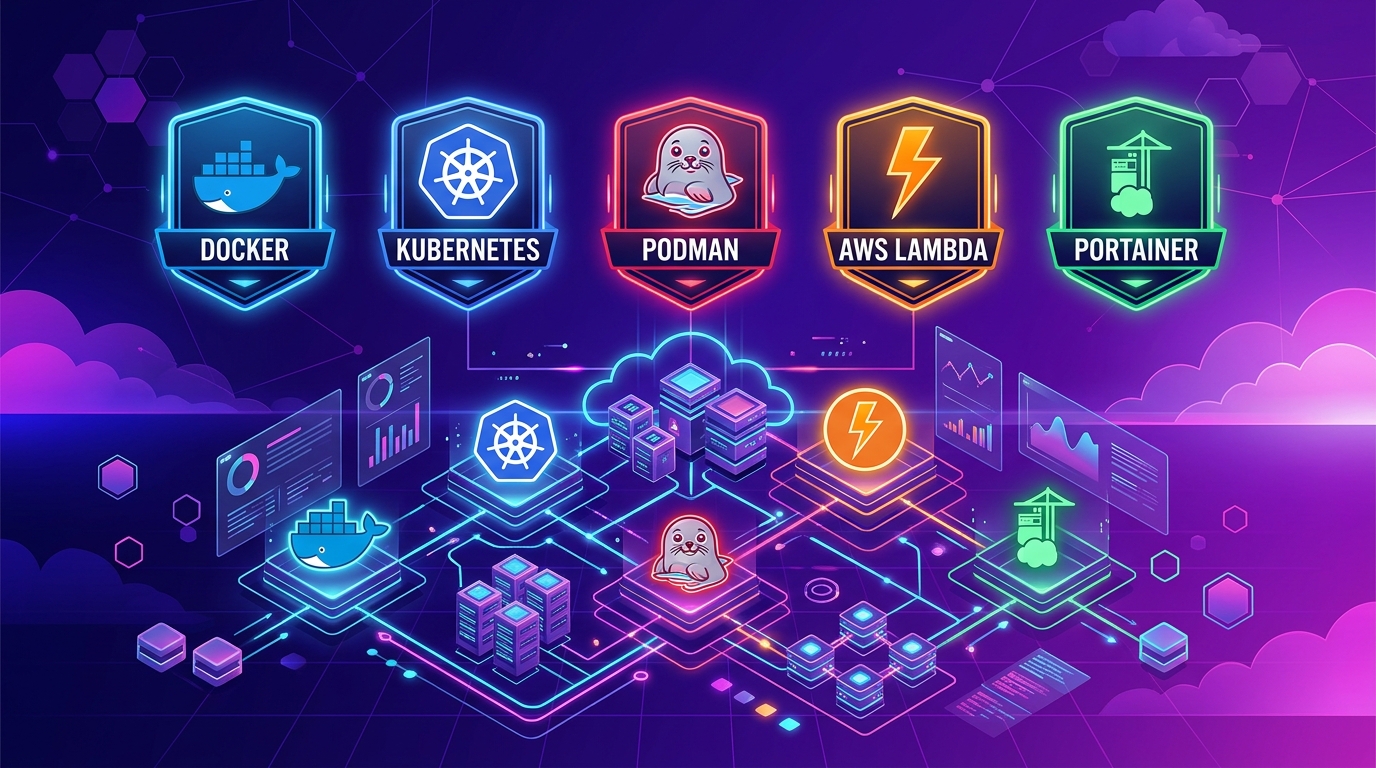
As of July 2026, the core cloud-native standard for packaging monolithic applications lightweightly and deploying them across cloud infrastructure is Container & DevOps Ecosystem technology. Moving beyond single servers to large-scale distributed clusters and serverless pipelines is a decisive factor for service scalability.
In July 2026, the criteria for selecting container technologies hinge on “Daemon presence and Rootless security, multi-node orchestration auto-healing specs, serverless cost efficiency, web GUI management convenience, and infrastructure operational costs”—the key metrics driving engineering productivity.
The five leading tools currently dominating the container and cloud deployment ecosystem—Docker (Docker Engine), Kubernetes (Kubernetes 1.30+), Podman (Podman v5.0), Amazon Lambda (AWS Lambda), and Portainer (Portainer v2.20+)—each innovate engineer DevOps workflows with their own distinct architectures.
Based on the latest data and real infrastructure benchmarks as of July 30, 2026, this comparative analysis of the 5 major container tools provides a detailed, data-driven comparison covering architectural specs, security isolation (Rootless), orchestration scale, serverless infrastructure, web GUI usability, and an optimal selection guide tailored to your project goals.
1. Executive Summary: The 5 Major Container Tools at a Glance (July 2026)
For busy DevOps engineers and backend developers, here is a comprehensive comparison table summarizing the core specs and key features of the top 5 container tools as of July 2026.
📊 Top 5 Container & DevOps Tools Comparison Table (July 2026)
| Feature | Docker | Kubernetes | Podman | AWS Lambda | Portainer |
|---|---|---|---|---|---|
| Core Design Philosophy | Container packaging & global dev standard | Large-scale distributed cluster orchestration | Rootless daemonless secure runtime | Zero-infrastructure serverless computing | Intuitive web-based container GUI monitoring |
| Architectural Structure | Client-daemon (dockerd) | Control plane & worker nodes | Daemonless (#1 in daemonless) | Event-driven serverless | Web browser dashboard |
| Security Isolation (Rootless) | Root privileges by default (Rootless optional) | Cluster RBAC security configuration | Highest (#1 in default Rootless security) | Full AWS IAM security | Web dashboard permission management |
| Auto-healing | Basic restart policy | Highest (#1 in auto-recovery & rolling updates) | systemd integration | AWS cloud auto-monitoring | GUI screen monitoring |
| CLI Compatibility | Docker CLI standard | kubectl CLI | 100% Docker compatible (alias docker=podman) | AWS CLI & SAM | Web browser mouse clicks |
| Learning Curve | Low (#1 in dev adaptability within 10 min) | High (Complex YAML & K8s concepts) | Low ~ Medium (Identical to Docker usage) | Medium (Requires understanding AWS ecosystem) | Low (#1 in GUI point-and-click management) |
| Main Licensing | Personal: Free Business: Paid | 100% Free Open Source (CNCF) | 100% Free Open Source (Apache) | On-demand pay-per-use | Community: Free BE: Paid |
| Best Target Audience | Individual developers, quick single-server deployments | Enterprises with high multi-node traffic | Strict security environments, Red Hat users | Backend devs wanting zero server maintenance | Beginner engineers deploying via GUI clicks |
2. Deep Dive into Core Features of the 5 Container Tools
The optimal tool depends on the nature of your application infrastructure: single container builds vs. large-scale cluster deployments vs. secure daemonless runtimes vs. serverless automated billing vs. web UI monitoring.
🐳 1) Docker (Docker Engine) - #1 Container Build & Global Standard
- Dockerfile & Compose: Compresses source code and dependencies into a single image file to execute consistently across any server environment.
- Overwhelming Database: Instantly pull hundreds of thousands of pre-built open-source images via Docker Hub.
☸️ 2) Kubernetes (Kubernetes / K8s) - #1 Large-Scale Orchestration
- Auto-healing & Rolling Deployments: If a container node crashes, it automatically provisions a new container and performs zero-downtime rolling updates for new versions.
- HPA (Horizontal Pod Autoscaling): Automatically scales out the number of container instances during spikes in CPU/memory traffic.
🦭 3) Podman (Podman v5.0) - #1 Rootless Daemonless Secure Runtime
- Daemonless & Rootless: Runs each container independently without a central daemon (
dockerd) and operates under unprivileged user accounts, fundamentally eliminating root exploit risks. - 100% Docker Compatibility: Simply setting
alias docker=podmanlets you use existing Docker commands seamlessly.
⚡ 4) AWS Lambda (Amazon Lambda) - #1 Event-Driven Serverless Computing
- Zero Server Management: No need to manage OS or container runtimes; pay strictly for actual code execution time (measured in milliseconds).
🐙 5) Portainer (Portainer v2.20+) - #1 Web GUI Container Management Dashboard
- Intuitive Point-and-Click Deployment: Monitor and deploy Docker and Kubernetes container states with a single click from a web dashboard without needing terminal commands.
3. Daemon Security and Orchestration Showdown
[Container Security Isolation & Large-Scale Orchestration Benchmark]
Podman                : ⭐⭐⭐⭐⭐ (#1 in Daemonless & Rootless Security)
Kubernetes (K8s)      : ⭐⭐⭐⭐⭐ (#1 in Large-Scale Cluster Orchestration)
AWS Lambda            : ⭐⭐⭐⭐☆ (AWS Serverless Managed Reliability)
Docker (Docker Engine): ⭐⭐⭐█☆ (Standard Runtime & Broad Ecosystem)
Portainer             : ⭐⭐⭐☆☆ (Intuitive GUI Monitoring)
4. Licensing and Cloud Operating Cost Showdown
[Service Licensing & Operational Cost Comparison]
- Kubernetes (K8s)        : 100% Free Open Source (CNCF)
- Podman                  : 100% Free Open Source (Apache 2.0)
- Portainer (Community)   : 100% Free (Up to 5 nodes)
- Docker (Personal)       : Free for individuals/small businesses (Paid subscription for enterprise)
- AWS Lambda              : Free tier includes 1 million monthly requests, followed by on-demand billing
5. Final Recommendation Guide by Role and Project Goal
Based on the analysis above, here is the ultimate guide categorized by “What kind of infrastructure architecture are you trying to build?”
🎯 1) Developers who want a fast dev environment and single-server container deployment
- Best Choice: Docker (Docker Engine)
- Reason: Ranks #1 with the largest ecosystem and standard Dockerfile usability.
🎯 2) Systems requiring a secure runtime in finance, government, or strict security environments
- Best Choice: Podman (Podman v5.0)
- Reason: Fundamentally eliminates root privilege hacking risks with its daemonless Rootless architecture.
🎯 3) Enterprises operating non-disruptive auto-healing services across tens to hundreds of server nodes
- Best Choice: Kubernetes (Kubernetes)
- Reason: Sets the global standard for Auto-healing and rolling deployment orchestration capabilities.
🎯 4) Backend developers who want to execute code only on events without server management overhead
- Best Choice: AWS Lambda (Amazon Lambda)
- Reason: Offers zero infrastructure server management and millisecond-level, cost-effective pay-per-use billing.
🎯 5) Beginners unfamiliar with CLI commands who want mouse-click monitoring on a web dashboard
- Best Choice: Portainer (Portainer)
- Reason: Provides a web browser-based GUI to monitor all container and K8s nodes at a glance.
6. Conclusion: Building Your Modern DevOps Workflow
The conclusion for container infrastructure in July 2026 is “a smart DevOps pipeline that fortifies development and security with Podman and Docker, monitors large-scale services with Kubernetes and Portainer, and processes events with AWS Lambda.”
Select the container tools that perfectly match your service scale to maximize engineering productivity and operational efficiency! 🐳⚡