Dyson vs. LG CordZero vs. Samsung Bespoke Jet vs. Xiaomi vs. Tineco: The Complete August 2026 Cordless Vacuum Comparison Guide
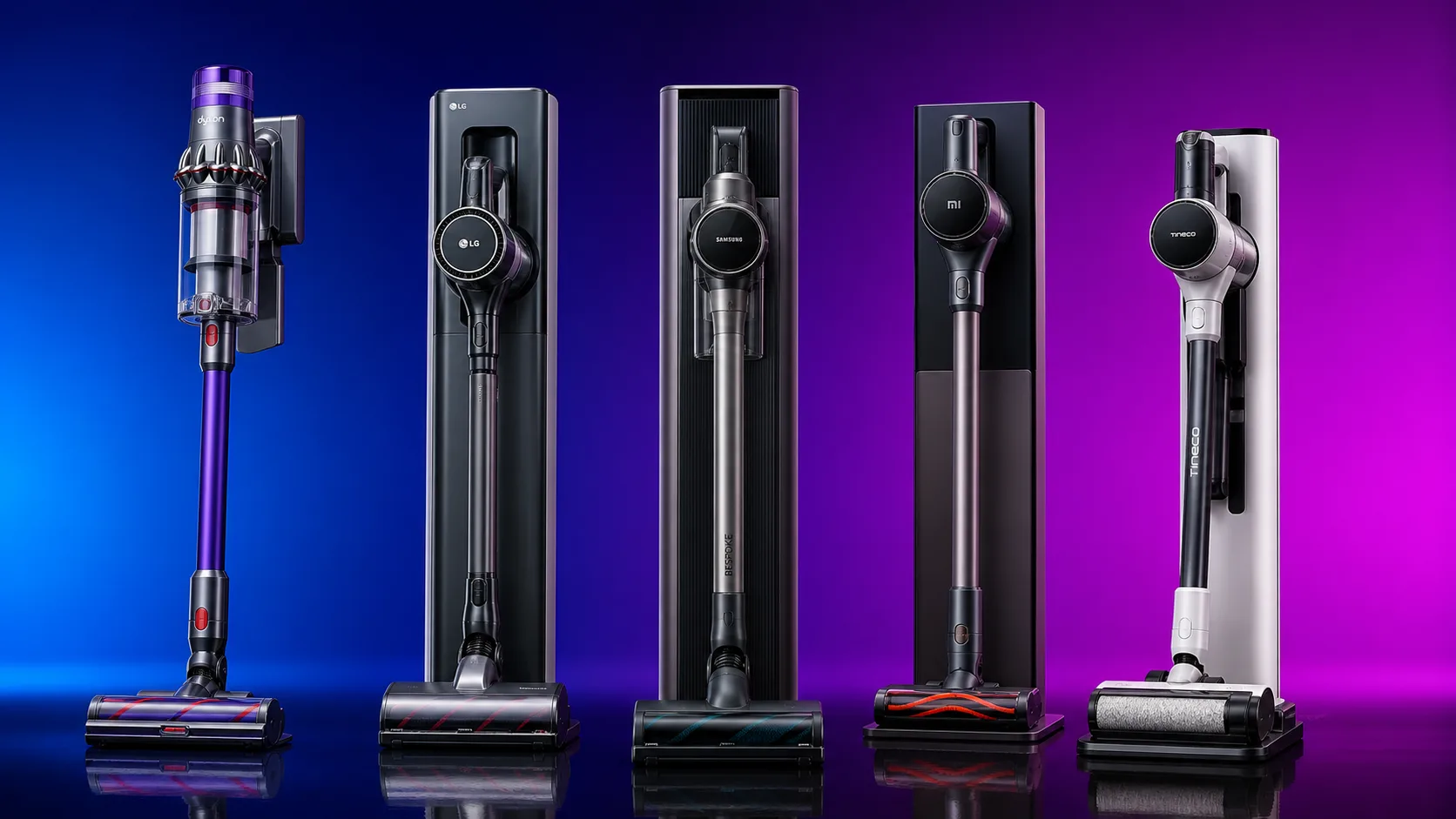
As of August 2026, more than half of vacuum cleaner sales in developed markets (over 59%, up from 43% in 2020) have shifted to cordless models. The corded vacuum’s era is winding down. The catch is that once you actually walk into a store, Dyson, LG, Samsung, Xiaomi, and Tineco each list suction power in a different unit (AW, W, or Pa), and the conditions hiding behind the phrase “maximum runtime” vary wildly from brand to brand — which makes a genuine cordless vacuum comparison based purely on spec sheets nearly impossible. About half of new models (roughly 55%) now ship with smart features like app connectivity, automatic sensors, and AI-assisted navigation, adding even more variables to weigh.
This isn’t about “which brand is more famous.” It’s a cordless vacuum comparison built solely on the specs and prices actually posted, as of August 2026, on each manufacturer’s official pages, press releases, and retail channels. Notably, the first half of this year saw Bosch unveil its premium North America-bound cordless stick vacuum, the Unlimited 9/10, at CES 2026, while Narwal’s S30 broke into the mop-vacuum category — signs that competition is heating up even outside the established top five. That’s exactly why getting the details right, right now, matters so much.
There’s one trap worth flagging up front. Dyson’s “Piston Animal” and “Submarine” versions are priced differently; Samsung’s “Bespoke AI Jet” and “Bespoke AI Steam” are entirely different product categories; Xiaomi’s China-only Mijia flagship line and the P30 officially launched in Korea belong to completely separate product families; and Tineco’s flagship lineup on its official Korean site differs from what’s sold through open marketplaces. Mix up any of these four distinctions and no amount of staring at spec sheets will save you from the wrong conclusion. Let’s untangle them one by one below.
This guide runs in the following order: a comprehensive comparison table, a feature deep-dive for each product, suction power and battery benchmarks, a full pricing breakdown, recommendations by user type, practical tips, and an FAQ. Wherever a figure couldn’t be confirmed, I’ve labeled it “not confirmed” rather than filling in an estimate — for those spots, I’d recommend double-checking the official product page right before you buy.
1. Executive Summary: The 2026 Cordless Vacuum Comparison at a Glance
For readers short on time, here’s the core information on all five brands condensed into a single table. That said, since suction-power units differ by brand (AW / W / Pa) and battery-life test conditions (standard mode / eco mode / max power) vary just as much, treat this table less as a basis for a strict numeric comparison and more as a way to see “what each brand is bragging about.”
📊 The Big Five Cordless Vacuums, Compared (August 2026)
| Category | Dyson | LG CordZero A9S | Samsung Bespoke AI Jet | Xiaomi | Tineco |
|---|---|---|---|---|---|
| Core design philosophy | Maximum suction, fully sealed filtration | Ultralight, multi-surface mopping | Premium all-in-one with clean station | High-value flagship (China) / ultralight budget (Korea) | All-in-one wet cleaning: mop + suction |
| Flagship current model | V16 Piston Animal (Submarine) / V10 Optic | A9S (250W/280W, multiple model codes) | Bespoke AI Jet 400W (VS90F40CSG) | Mijia 4 Max (China) / P30 (official Korea launch) | Pure ONE S15 Essentials (open marketplace) |
| Peak suction power | 315AW (V16) / 150AW (V10 Optic) | 250W–280W (LG’s own unit) | 400W (Samsung’s own unit, +29% YoY) | 280AW / 27,000Pa (4 Max) / 22,000Pa (P30) | Not confirmed (global Pure ONE X reference: 80AW) |
| Battery life (standard) | Not confirmed (V10 only says “20 min longer than before”) | 30–60 min (sources disagree) | 100 min (standard) / 1 min (Jet max-power boost) | 90 min (eco, 4 Max) / 45 min (P30) | 45 min (global Pure ONE X reference) |
| Weight | Not confirmed | ~2.47 kg (250W model) | ~2.67 kg (with brush attached) | Not confirmed (China model) / 860 g (P30, handheld) | ~1.27 kg (global Pure ONE X reference) |
| Auto-empty dock | Only the V10 Optic has one (Auto-empty Dok, holds up to 60 days of dust) | Separate All-in-One Tower option | Included by default with the Clean Station | On the Mijia 4 Pro/4 Max (11-second auto-collection) | Not confirmed (differs between official and open-market lines) |
| Korea price (confirmed) | Submarine ₩1,490,000 ( | ₩1,590,000 (250W, ~$1,104) / ₩1,740,000 (280W, ~$1,208), per a 2023 press release | Confirmed price not disclosed (only promotional pricing shown) | P30 | Pure ONE X ₩467,600 ( |
| Strengths | Dominant on-paper suction, fully sealed filtration | Claims class-leading light weight, 3 mopping modes | Clean Station included by default, large-capacity battery | Choose either the ultra-budget line (P30) or the high-performance line (4 Max) | All-in-one mop + suction, frequent open-marketplace discounts |
| Weaknesses | Flagship pricing is steep; battery and weight specs undisclosed | Current retail price needs re-checking; battery specs are inconsistent across sources | Confirmed retail price undisclosed; Jet max-power mode lasts only briefly | Unclear whether the China flagship line will officially launch in Korea | Hard to pin down a single “latest official flagship” |
| Best for | Suction power above all, with a premium budget | Households that prioritize light weight and multi-surface mopping | Users who want auto-emptying and a large battery in one package | Minimizing budget (P30) or maximizing specs (4 Max, imported) | Households that want mop-centric wet cleaning |
(KRW figures in this article are converted to approximate USD at roughly ₩1,440 = US$1, and CNY figures at roughly ¥7.2 = US$1 — treat these as rough reference points, not exact billing amounts.)
The two rows to read most carefully here are “peak suction power” and “Korea price.” Three different units — AW, W, and Pa — are mixed together, so comparing raw numbers alone is a recipe for misunderstanding, and neither Samsung nor Tineco has disclosed a confirmed retail price, meaning you have to judge by promotional terms or retail-channel pricing instead. The sections below untangle these traps brand by brand.
2. Deep Dive: Core Features of the Big Five Cordless Vacuums
🌪️ 1) Dyson — The Benchmark for On-Paper Suction Power
- V16 Piston Animal (Submarine, model code DS60): Officially rated at 315AW of suction from a 900W motor, this model launched first in Korea in 2025 before rolling out globally. The Submarine version pairs with a mop roller head (Submarine 2.0), and the All Floor Cones Sense head automatically detects the floor surface to adjust suction and conserve battery. As of August 2026 it’s still Dyson Korea’s top-tier flagship, confirmed to sell for ₩1,490,000 (~$1,035) in the Submarine configuration (the exact Korean retail price for the base version without the mop head has not been confirmed).
- V10 Optic + Auto-empty Dok: Unveiled on July 1, 2026, this is Dyson’s first budget-to-mid-tier line to pair a stick vacuum with an “automatic dust-emptying” dock. It’s rated at 150AW of suction, 15 cyclones, a digital motor spinning up to 110,000 rpm, and a fully sealed 5-stage double HEPA filtration system that’s stated to remove 99.99% of particles down to 0.1 microns. The Auto-empty Dok can hold up to 60 days’ worth of dust, and Dyson’s materials describe “up to 20 minutes longer cleaning time than before” — though no absolute runtime figure (in minutes) appears anywhere in the coverage. It’s priced at ₩990,000 (~$688) in Korea.
- Battery life and weight are officially unconfirmed for both models: Neither Dyson Korea’s domestic press coverage nor its press releases specify an actual “real-world standard-mode runtime (minutes)” or “unit weight (kg).” Before you commit to a purchase, it’s safer to check Dyson’s official product detail page directly.
- Filtration is a strength shared across the entire lineup: A fully sealed filtration system is standard across every Dyson model, though whether it’s washable varies by model.
🏠 2) LG CordZero A9S Objet Collection — The Lightweight, Multi-Surface Mopping Powerhouse
- A9S is still LG’s top line: As of August 2026, there’s no confirmed report that LG Electronics has released an entirely new series above the A9S. Multiple model codes exist across colors and configurations — AX9884TE, AX9884WE, the A9700 series, AU9982CD/WD, and more — sold in Objet Collection colorways like Calming Beige, Calming Green, and Essence Graphite.
- Suction is measured in W, across two tiers — 250W and 280W: Rather than the AW unit Dyson and Samsung use, LG sticks with its own W (watt) rating. The base tier tops out at 250W and the upper tier at 280W; power consumption for the AX9884TE is listed as 620W on Danawa, a Korean price-comparison and specs site.
- Claims class-leading light weight at ~2.47 kg: LG says the A9S is “the lightest among premium cordless vacuums in its class”; the 250W model weighs roughly 2.47 kg (the 280W model’s weight has not been separately confirmed).
- Battery life differs depending on the source: LG’s newsroom press release states up to 60 minutes in standard mode on a single battery, while Danawa’s spec sheet for the AX9884TE lists “up to 30 minutes,” a 4-hour charge time, and two detachable batteries (25.2V lithium-ion). The accurate way to state it, then, is a range of 30–60 minutes — the sources simply disagree on which figure is the confirmed one.
- 3 mopping modes plus an All-in-One Tower: It supports three mopping modes — steam, hot water, and standard — comes with a 2.5L dust bag capacity, and a washable HEPA filter. If you want automatic dust-emptying, the optional All-in-One Tower handles charging, dust-bin emptying, and accessory storage all in one unit.
- Careful: the price is from a 2023 press release: The confirmed prices are ₩1,590,000 (~$1,104) for the 250W model and ₩1,740,000 (~$1,208) for the 280W model, but those figures come from LG Electronics’ newsroom press release dated April 24, 2023. As of August 2026, actual retail-channel prices — on SSG (Shinsegae’s e-commerce platform), Himart (Lotte’s electronics retail chain), GS Shop (a Korean home-shopping channel), and similar outlets — swing widely depending on the bundle (whether the All-in-One Tower is included), ranging anywhere from ₩859,000 (~$597) in bundle-discount cases to over ₩1,500,000 (~$1,042+). Treat these figures as the “launch price,” not the current list price.
✨ 3) Samsung Bespoke AI Jet — Premium All-in-One with a Clean Station
- The current flagship is the 400W: Samsung’s latest 2026 model is the Bespoke AI Jet 400W (model VS90F40CSG / VS90F40CSK). Samsung’s official page states a “29% improvement over the 2024 model’s max 310W” — a confirmed year-over-year gain, though no Pa-unit conversion has been published.
- The budget tier is the 220W: A lower-tier line exists in the Bespoke Jet 220W (VS20B956D5G / VS20B957D5G), which uses a 2,200mAh battery and is advertised to “hold its initial suction power for a full hour” — though the exact suction-decay curve hasn’t been published.
- Battery life differs completely depending on mode: The 400W model packs a large 3,970mAh battery good for up to 100 minutes in standard mode, but the max-power Jet mode is a momentary boost that lasts only about 1 minute. Don’t mistake this for “100 minutes at full power” — you always have to read the mode condition alongside the number.
- Clean Station included by default: The 400W model ships standard with a Clean Station that blocks 99.999% of fine-dust exhaust and includes UV LED sterilization. With the brush attached, it weighs about 2.67 kg.
- No confirmed retail price has been disclosed: Samsung’s official site (Samsung.com) only shows a “maximum-benefit price” that already factors in promotional conditions like card discounts and 24-month interest-free installments — the confirmed list price / actual-sale KRW figure isn’t available. The amount you’d actually pay depends on whatever promotion is running when you buy.
- Warning: don’t confuse this with “Bespoke AI Steam”: The separately-announced 2026 “Bespoke AI Steam” line is a robot vacuum / steam mop, a completely different product category from the cordless stick vacuum (Bespoke Jet) covered in this comparison. Prices mentioned in the ₩1,590,000–₩2,080,000 (~$1,104–$1,444) range refer to the steam robot vacuum, not the Jet stick vacuum.
🔋 4) Xiaomi (Mijia) — Two Completely Separate Product Lines
- China’s domestic Mijia 4 series (rolled out April–June 2026): The lineup was completely overhauled with the budget 4C (launched April 21, ¥799/
$111), the base 4 (May 10, ¥999/$139), the 4 Pro with an auto-dust-collection dock (May 26, ¥1,499/$208, as low as ¥1,219/$169 with subsidies), and the flagship 4 Max (launched May, ¥1,999/~$278). The 4 Max runs an 800W motor at 150,000 rpm, delivers 280AW / 27,000Pa of suction, and its removable 4,000mAh battery lasts up to 90 minutes; its dual-airflow auto-collection system transfers dust into a 3L antibacterial silver-ion dust bag in 11 seconds, at a 99% collection rate, with a 100-day bag-replacement cycle. That said, whether this series has officially launched in Korea has not been confirmed. - The P30 is what’s officially launched in Korea: Not a stick vacuum but an ultralight handheld model, it was reported by Electronic Times (a Korean tech-industry newspaper) on December 30, 2025 to be rolling out across Korea starting January 2026. It’s an ultralight unit weighing just 860g, rated for up to 22,000Pa of suction, with a 5-stage micron filter, one-touch dust-emptying, and up to 45 minutes of runtime per charge. The Korean launch price is reported to sit around ₩90,000 (~$63), roughly 30% cheaper than the standard global price of about $110.
- Why you shouldn’t mix these up: The Mijia 4 series is a stick-vacuum flagship line (with an auto-collection dock), while the P30 is a budget handheld product (no auto-emptying) — so a claim like “Xiaomi’s newest cordless vacuum just launched in Korea for ₩90,000” conflates specs from two entirely different lines and is simply wrong.
- 4 Pro’s detailed specs: A 120,000 rpm motor, 230AW / 25,000Pa suction, a removable 2,600mAh battery good for up to 90 minutes in eco mode, a dual-airflow auto-collection dock, and 180-degree blue-light dust detection.
💧 5) Tineco — Two Coexisting Retail Lines
- The flagship line on the official site is a mop-plus-suction all-in-one: The flagship products on Tineco Korea’s official site (kr.tineco.com) are the FLOOR ONE S3 and iFloor 3, both wet/dry hybrid cleaners that handle mopping and suction simultaneously. This is an entirely different category from the traditional “stick vacuum + dock” structure — where you empty a separate dust bin — used by Dyson and LG. The Korean retail prices for these two models have not been confirmed.
- A separate stick-vacuum line is sold through open marketplaces: On open marketplaces like 11st (a major Korean online marketplace), you’ll find the Pure ONE X Essentials (₩467,600 / ~$325) and the Pure ONE S15 Essentials (₩884,700 / ~$614), both stick-vacuum designs that compete directly with Dyson. Per the global spec sheet (it’s not confirmed whether this is fully identical to the Essentials version sold in Korea), the Pure ONE X runs a 260W digital motor rated for up to 80AW of suction, with smart battery management good for up to 45 minutes, and weighs about 1.27 kg (2.8 lbs). The Pure ONE S15 Essentials has an iLoop™ smart dust sensor, but its specific suction and battery figures haven’t been confirmed.
- Whether the global top-tier line will launch in Korea is unclear: The FLOOR ONE S9 Artist (in Steam and PRO versions), unveiled on July 17, 2025, is Tineco’s global flagship line, but whether — or at what price — it will launch in Korea hasn’t been confirmed.
- It’s hard to pin down a single “Tineco’s latest model”: Because the official site focuses on wet all-in-one units and open marketplaces focus on stick vacuums — two completely different lines — you need to first decide which channel and which product category you’re shopping for before you buy.
Much like how map and navigation apps each use different search methods and data sources (as covered in our Naver Map vs. KakaoMap vs. TMAP vs. Google Maps comparison), cordless vacuums vary just as much brand to brand in how they present specs and structure retail channels — making it trickier than it looks to line everyone up “on equal terms.”
3. Suction Power and Battery Benchmarks Head-to-Head
Since suction-power units (AW/W/Pa) differ by brand and battery-life test conditions (standard mode / eco mode / max power) vary just as much, let me state up front: the ranking below is based on “the highest figure each brand has officially disclosed” and shouldn’t be read as a definitive performance ranking.
[Highest officially disclosed suction figures as of August 2026 — note: units differ]
Dyson V16 Piston Animal      : ⭐⭐⭐⭐⭐ 315AW (paired with fully sealed filtration)
Xiaomi Mijia 4 Max (China)   : ⭐⭐⭐⭐☆ 280AW / 27,000Pa
Samsung Bespoke AI Jet 400W  : ⭐⭐⭐⭐☆ 400W (own unit, +29% YoY)
LG CordZero A9S (280W)       : ⭐⭐⭐☆☆ 280W (own unit)
Dyson V10 Optic              : ⭐⭐⭐☆☆ 150AW (paired with auto dust-emptying)
Xiaomi P30 (Korea launch)    : ⭐⭐☆☆☆ 22,000Pa (handheld, built around 860g light weight)
Tineco Pure ONE X : ⭐⭐☆☆☆ 80AW (global spec reference)| Product | Suction Power | Battery (standard) | Weight | Auto-Empty | Price (reference) |
|---|---|---|---|---|---|
| Dyson V16 Piston Animal Submarine | 315AW | Not confirmed | Not confirmed | Separate dock not confirmed | ₩1,490,000 (~$1,035) |
| Dyson V10 Optic + Auto-empty Dok | 150AW | “20 min longer than before” (absolute figure unknown) | Not confirmed | Yes (holds up to 60 days) | ₩990,000 (~$688) |
| LG CordZero A9S (250W) | 250W (own unit) | 30–60 min (sources disagree) | 2.47 kg | All-in-One Tower option | ₩1,590,000 (~$1,104), 2023 press-release price |
| LG CordZero A9S (280W) | 280W (own unit) | Not confirmed | Not confirmed | All-in-One Tower option | ₩1,740,000 (~$1,208), 2023 press-release price |
| Samsung Bespoke AI Jet 400W | 400W (+29% YoY) | 100 min (standard) / 1 min (Jet mode) | 2.67 kg | Clean Station included | Not confirmed (only promo price shown) |
| Samsung Bespoke Jet 220W | 220W (own unit) | Not confirmed | Not confirmed | Not confirmed | Not confirmed |
| Xiaomi Mijia 4 Max (China) | 280AW/27,000Pa | 90 min | Not confirmed | Yes (11-sec auto-collection) | |
| Xiaomi Mijia 4 Pro (China) | 230AW/25,000Pa | 90 min (eco) | Not confirmed | Yes | |
| Xiaomi P30 (Korea launch) | 22,000Pa | 45 min | 0.86 kg | No (one-touch manual emptying) | |
| Tineco Pure ONE X Essentials | 80AW (global spec reference) | 45 min | ~1.27 kg | Not confirmed | ₩467,600 (~$325) |
| Tineco Pure ONE S15 Essentials | Not confirmed | Not confirmed | Not confirmed | Not confirmed | ₩884,700 (~$614) |
Looking purely at the numbers, Dyson’s 315AW looks overwhelming, but that’s the on-paper maximum paired with fully sealed filtration — in real-world use, the automatic floor-detection feature (All Floor Cones Sense) throttles suction to conserve battery. Conversely, Samsung’s “400W, +29% YoY” for the Bespoke AI Jet is measured in its own proprietary unit, with no established basis for converting it directly against Dyson’s or Xiaomi’s AW/Pa figures. In a cordless vacuum comparison like this one, rather than pulling out a single number and declaring a winner, it’s safer to first decide on your real-world priorities — do you want fully sealed filtration? do you need an auto-emptying dock? do you need mopping built in? — and then find the spec that matches those priorities.
The single most important detail to catch on battery life is Samsung’s Bespoke AI Jet combo of “100 minutes (standard) / 1 minute (Jet mode).” If you just read “up to 100 minutes” off the spec sheet, it’s easy to assume you get 100 minutes at maximum suction — but in reality, the 100-minute standard mode and the 1-minute max-power instant boost are two entirely separate conditions. LG CordZero A9S’s “30–60 minutes” shows nearly as wide a gap depending on the source (newsroom press release vs. Danawa’s spec sheet), so it’s safer to re-verify real-world battery life on the latest official product page before you buy.
4. Full Pricing Comparison
[Confirmed Korea prices, low to high]
Xiaomi P30 (Korea)               : ~₩90,000 (~$63)      (ultralight handheld, no auto-emptying)
Tineco Pure ONE X Essentials     : ₩467,600 (~$325)     (stick vacuum, open marketplace)
Dyson V10 Optic + Auto-empty Dok : ₩990,000 (~$688)     (includes auto dust-emptying)
Tineco Pure ONE S15 Essentials   : ₩884,700 (~$614)     (stick vacuum, open marketplace)
LG CordZero A9S (250W)           : ₩1,590,000 (~$1,104) (2023 press-release price)
Dyson V16 Piston Animal Submarine: ₩1,490,000 (~$1,035) (top-tier, mop-combo)
LG CordZero A9S (280W)           : ₩1,740,000 (~$1,208) (2023 press-release price)
Samsung Bespoke AI Jet 400W      : Not confirmed         (only promotional pricing shown)
💰 Detailed Price Comparison Table
| Product | Confirmed Price | Notes |
|---|---|---|
| Dyson V16 Piston Animal Submarine (DS60) | ₩1,490,000 (~$1,035) | Per Danawa price comparison; base version without mop head not separately confirmed |
| Dyson V10 Optic + Auto-empty Dok | ₩990,000 (~$688) | Suggested retail price, launched July 1, 2026 |
| LG CordZero A9S (250W) | ₩1,590,000 (~$1,104) | Per LG Electronics newsroom press release, April 24, 2023 |
| LG CordZero A9S (280W) | ₩1,740,000 (~$1,208) | Same source as above; may differ from actual August 2026 retail price |
| Samsung Bespoke AI Jet 400W | Not confirmed | Samsung.com only shows a promotional “benefit price” conditional on card discounts and interest-free installments |
| Samsung Bespoke Jet 220W | Not confirmed | Same as above |
| Xiaomi Mijia 4C (China) | ¥799 (~₩150,000 / ~$104) | Presumed not launched in Korea |
| Xiaomi Mijia 4 (China) | ¥999 (~₩190,000 / ~$132) | Presumed not launched in Korea |
| Xiaomi Mijia 4 Pro (China) | ¥1,499 ( | Presumed not launched in Korea |
| Xiaomi Mijia 4 Max (China) | ¥1,999 ( | Presumed not launched in Korea |
| Xiaomi P30 (Korea) | About 30% cheaper than the global price of roughly $110 | |
| Tineco Pure ONE X Essentials | ₩467,600 (~$325) | 11st |
| Tineco Pure ONE S15 Essentials | ₩884,700 (~$614) | 11st |
| Tineco FLOOR ONE S3 / iFloor 3 | Not confirmed | Flagship line on Tineco Korea’s official site; list price undisclosed |
There are three traps you absolutely need to watch for in this price comparison. First, LG CordZero A9S’s ₩1,590,000/₩1,740,000 are 2023 press-release figures, not 2026 list prices. Real retail channels (SSG, Himart, GS Shop, and others) have seen bundle deals with the All-in-One Tower drop as low as ₩859,000 (~$597) — mistaking these older numbers for “today’s list price” will throw off your budget. Second, Samsung’s Bespoke AI Jet 400W has no disclosed confirmed retail price at all. The price shown on Samsung.com is a promotional “benefit price” that assumes card discounts and 24-month interest-free installments, so what you’d actually pay depends on your card issuer and the timing of your purchase. Third, don’t just convert the yuan prices of Xiaomi’s China-domestic Mijia series into won and assume “I can buy this in Korea for that amount.” Whether this line has officially launched in Korea at all hasn’t been confirmed, and if you import it directly or through a parallel-import channel, customs duties and shipping will push the real cost well above the listed price.
Just as picking a cloud storage plan means carefully weighing free-tier limits against paid-tier terms (a logic covered in our Google Drive vs. OneDrive vs. iCloud vs. Dropbox vs. Naver MYBOX cloud storage comparison), it pays to figure out ahead of time the gap between a cordless vacuum’s “listed price” and what you’ll actually pay at checkout when you’re planning your budget.
5. Final Recommendations by User Type
🎯 1) Single Households or Pet Owners Who Prioritize Suction Power and Have Room in the Budget
- Best pick: Dyson V16 Piston Animal Submarine
- Why: With an on-paper peak of 315AW, fully sealed filtration, and a mop-combo roller head, it’s built for moments where raw suction matters most — like vacuuming up pet hair. That said, since battery and weight specs aren’t disclosed, I’d recommend checking real-world runtime in person at a store.
🎯 2) Newlyweds or Single-Person Households Wanting Their First Taste of Auto-Emptying at a Mid-Range Price
- Best pick: Dyson V10 Optic + Auto-empty Dok
- Why: For ₩990,000 (~$688), you get both an auto-emptying dock (holding up to 60 days’ worth of dust) and 5-stage double HEPA filtration — a relatively accessible combination within the Dyson lineup.
🎯 3) Multi-Person Households That Want Mopping Built In and a Light Feel in Hand
- Best pick: LG CordZero A9S
- Why: It leads with a class-leading light weight around 2.47 kg and supports three mopping modes — steam, hot water, and standard — giving it an edge for multi-surface cleaning. Just keep in mind the list price is from a 2023 press release, so be sure to re-check the current retail-channel price before you actually buy.
🎯 4) Households That Want an Auto-Empty Station and a Large Battery in One Package
- Best pick: Samsung Bespoke AI Jet 400W
- Why: It comes with a Clean Station included by default, and its large 3,970mAh battery delivers 100 minutes in standard mode. If you also need UV LED sterilization, this is the only option in this comparison that offers it. Just note that no confirmed retail price is available, so check the actual amount you’d pay in-store or on Samsung.com beforehand.
🎯 5) Single-Person Households Wanting a Light, Minimal-Budget Secondary Vacuum
- Best pick: Xiaomi P30
- Why: At 860g, this ultralight handheld is officially priced around ₩90,000 (~$63) in Korea — the cheapest option in this entire comparison. But it lacks auto-emptying and is capped at 45 minutes of battery life, making it better suited as a secondary tool for tight spots than a primary vacuum.
🎯 6) Households That Want Mop-Centric Wet Cleaning in Stick-Vacuum Form
- Best pick: Tineco Pure ONE X/S15 Essentials (open marketplace) or the FLOOR ONE S3/iFloor 3 on the official site
- Why: If you need a stick vacuum that competes directly with Dyson, go with the Pure ONE line on open marketplaces; if you need wet/dry all-in-one cleaning, go with the FLOOR ONE/iFloor line on the official site — split your approach by retail channel depending on what you actually need.
6. Practical Tips and Common Mistakes
✅ Tip 1: Never Confuse Samsung’s “Bespoke AI Jet” with “Bespoke AI Steam”
It’s a common mistake to see just the name “Bespoke AI” in a portal search or in-store display and assume the steam robot vacuum and the Jet stick vacuum are the same product. Prices mentioned in the ₩1,590,000–₩2,080,000 (~$1,104–$1,444) range refer to the steam robot vacuum — a completely different category from the cordless stick vacuum (Bespoke Jet) covered in this comparison. Before you buy, always double-check whether the model name says “Jet” or “Steam.”
✅ Tip 2: Search Xiaomi’s “China-Domestic” and “Officially Launched in Korea” Lines Separately
The Mijia 4/4C/4 Pro/4 Max line only has information available through local Chinese channels like JD.com, and whether it’s officially launched in Korea hasn’t been confirmed. What has officially launched in Korea is the ultralight handheld P30. When you search “Xiaomi cordless vacuum,” mixing the specs and prices of these two lines means you’re effectively comparing two entirely different products, so be careful.
✅ Tip 3: Treat LG A9S Pricing as a “Launch Price,” Not the Current List Price
The confirmed ₩1,590,000/₩1,740,000 figures come from an April 2023 press release. As of August 2026, actual retail-channel prices on SSG, Himart, GS Shop, and similar outlets vary widely — from ₩859,000 ($597) up to over ₩1,500,000 ($1,042+) — depending on whether the All-in-One Tower is included. Always re-check the live retail price right before you buy.
✅ Tip 4: Always Read Battery “Maximum Runtime” Alongside Its Test Condition
Samsung’s Bespoke AI Jet’s “100 minutes” is measured in standard mode, while its max-power Jet mode lasts only about 1 minute. LG’s A9S has both 30-minute and 60-minute figures floating around depending on the source. When you look at a battery spec, make it a habit to check “under which mode” before you check “how many minutes.”
✅ Tip 5: Auto-Empty Docks Are Becoming Standard on Premium Models
The Dyson V10 Optic, Samsung Bespoke AI Jet, and Xiaomi Mijia 4 Pro/4 Max all come with an auto-empty station. LG’s All-in-One Tower, though, is a separate option, and Tineco hasn’t clearly disclosed auto-emptying specs for its official-line products. If auto-emptying is a must-have for you, check first whether it comes included by default or has to be purchased separately.
✅ Tip 6: Decide Which Channel You’re Buying Tineco From First
Tineco Korea’s official site (wet all-in-one units led by the FLOOR ONE S3 and iFloor 3) and open marketplaces (the stick-vacuum Pure ONE X/S15 Essentials) sell two completely different product lines. Before you ask “what’s Tineco’s latest model,” first decide whether you need a mop all-in-one or a stick vacuum — that’ll make your search a lot faster.
7. Frequently Asked Questions (FAQ)
Q. In an August 2026 cordless vacuum comparison, what should I check first?
Start by checking that suction-power units (AW/W/Pa) differ by brand, and figure out which mode the “maximum runtime” battery figure is based on. After that, checking whether an auto-empty dock is included and the actual price you’d pay at checkout (including promotional conditions, not just the list price) covers most of the key variables in this cordless vacuum comparison.
Q. Should I buy the Dyson V16 or the V10 Optic?
If suction power and mopping are your top priorities, the 315AW V16 Piston Animal Submarine (₩1,490,000 / ~$1,035) is the right call; if you want to try an auto-empty dock at a relatively lower price (₩990,000 / ~$688), go with the V10 Optic. Since neither model has disclosed battery or weight specs, though, I’d recommend testing runtime yourself in-store if that’s a priority for you.
Q. What’s the exact price of the Samsung Bespoke AI Jet 400W?
Unfortunately, Samsung.com only shows a “maximum benefit price” that already factors in card-discount and interest-free promotions — the confirmed retail (list) price itself isn’t published. The amount you’d actually pay depends on your card issuer and whatever event is running at the time, so the most accurate approach is to check in real time, in-store or on Samsung.com.
Q. Can I buy a Xiaomi cordless vacuum in Korea?
The ultralight handheld P30 officially launched in Korea starting January 2026 and can be bought for around ₩90,000 (~$63). The stick-vacuum flagships popular in China, though — the Mijia 4/4 Pro/4 Max — haven’t been confirmed to have an official Korean launch, and your only options may be direct overseas ordering or parallel imports.
Q. What’s Tineco’s latest 2026 flagship model called?
It’s hard to name just one. Tineco Korea’s official site leads with the mop-plus-suction all-in-one units FLOOR ONE S3 and iFloor 3, while the open marketplace 11st separately sells the stick-vacuum Pure ONE X/S15 Essentials. The global top-tier line, the FLOOR ONE S9 Artist, was unveiled in July 2025, but whether it will launch in Korea hasn’t been confirmed.
Q. Is a new model coming soon to replace the LG CordZero A9S?
As of August 2026, there’s no confirmed report of an entirely new series above the A9S (something like an “A10-class” model) being released. Refreshes seem to be continuing mostly around colors and bundle configurations (like All-in-One Tower sets), but a full generational replacement hasn’t been officially confirmed either way.
Q. Do I really need an auto-empty station?
If you’re a multi-person household or a pet owner who finds emptying the dust bin frequently a hassle, the convenience is definitely worth it. Some models — the Dyson V10 Optic, Samsung Bespoke AI Jet, and Xiaomi Mijia 4 Pro/4 Max — already include it by default, while LG’s All-in-One Tower is a separate option that adds to the cost. It’s worth weighing your budget against how much you actually need it before deciding.
Q. Can I convert between suction-power units (AW, W, Pa)?
This research didn’t find an official conversion formula between brands. AW (Air Watts) is used by Dyson, Xiaomi, and Tineco; Pa (Pascals) is listed alongside it by Xiaomi; and LG and Samsung both use their own proprietary W (watt) ratings. Since these are fundamentally different measurement methods, a relative comparison — like “how many percent better is this than the same brand’s previous generation” — is safer than comparing raw numbers directly.
8. Conclusion: The Practical Takeaway from This 2026 Cordless Vacuum Comparison
The most important takeaway from this August 2026 cordless vacuum comparison is: decide on the conditions that fit your own cleaning habits before you get swayed by “brand-name value.” Looking purely at suction specs, Dyson’s V16 at 315AW stands out — but if you value mopping and light weight, LG’s CordZero A9S may be the better choice; if you want auto-emptying and a large battery together, Samsung’s Bespoke AI Jet may serve you better; and if minimizing your budget is the priority, Xiaomi’s P30 could be the smarter pick.
In particular, the traps that kept surfacing throughout this research — mixing up Samsung’s Jet and Steam lines, confusing Xiaomi’s China-domestic and officially-launched-in-Korea lines, conflating Tineco’s official site and open-marketplace offerings, and mistaking LG’s 2023 press-release price for its actual 2026 selling price — are exactly the kind of thing that can throw your budget badly off track when you’re actually making the purchase. Double-checking these four traps one more time before you finalize a purchase, in-store or online, will help you avoid the vast majority of buying mistakes.
Just as choosing an AI model means weighing actual benchmarks and conditions over surface-level name recognition (an approach covered in our ChatGPT vs. Claude vs. Gemini vs. DeepSeek AI model comparison), checking the real test conditions and confirmed price behind a cordless vacuum — rather than its flashiest spec headline — is what leads to a choice you won’t regret.
[Summary: Final recommendation for your situation]

Suction power above all, premium budget available
  → Dyson V16 Piston Animal Submarine (315AW, ₩1,490,000 / ~$1,035)

First taste of auto-emptying at a mid-range price
  → Dyson V10 Optic + Auto-empty Dok (150AW, ₩990,000 / ~$688)

Mopping combo + light weight, multi-person household
  → LG CordZero A9S (250W/280W, ~2.47 kg, launch price ₩1,590,000–1,740,000 / ~$1,104–$1,208)

Need auto-emptying and a large battery together
  → Samsung Bespoke AI Jet 400W (100 min standard mode, Clean Station included)

Minimize budget, secondary/tight-spot cleaning
  → Xiaomi P30 (860g, ~₩90,000 / ~$63, officially launched in Korea)

Mop-centric stick vacuum (open marketplace) or wet all-in-one (official site)
  → Tineco Pure ONE X/S15 Essentials or FLOOR ONE S3/iFloor 3
Build your own checklist first — around suction-power units, battery test conditions, whether auto-emptying is included, and confirmed pricing, rather than the brand name — and by the time you walk into a store, you’ll have sidestepped most of the traps this cordless vacuum comparison has flagged.