PostgreSQL vs MySQL vs MongoDB vs Redis vs DynamoDB: Ultimate 2026 Database Comparison Guide
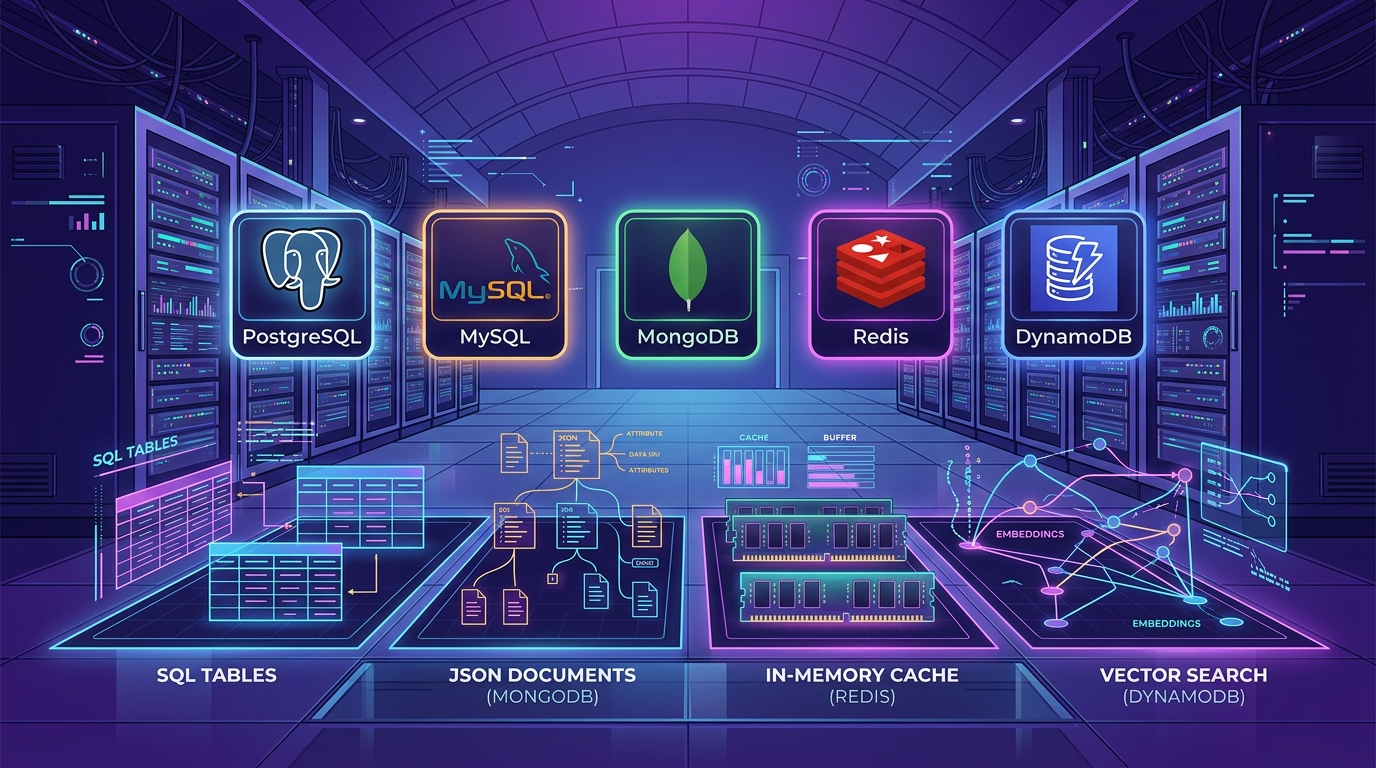
As of July 2026, Database Management Systems (DBMS) serve as the critical backend foundation powering mobile apps, large-scale web services, AI RAG vector search, and real-time financial transactions. A system’s architectural stability, throughput, and scalability often dictate the success or failure of a modern service.
The key criteria for selecting a database today revolve around “Relational (RDBMS) vs. NoSQL vs. In-Memory architectures, ACID transaction guarantees for payments, AI vector search (pgvector) scalability, cloud serverless autoscaling, and operational costs.” These metrics are top-of-mind for backend developers and data engineers alike.
The five dominant database management systems leading the current ecosystem—PostgreSQL 17, MySQL 8.4, MongoDB 8.0, Redis 7.4 / Valkey, and Amazon DynamoDB—are innovating enterprise systems with their unique data engine architectures.
This guide provides an in-depth, data-driven comparison of these top 5 databases based on July 2026 benchmarks and real-world backend performance. We compare their architectural specs, transaction handling (ACID vs. BASE), in-memory speeds, AI vector search support, cloud pricing models, and recommended choices based on project requirements.
1. Executive Summary: Top 5 Databases at a Glance (July 2026)
For busy backend engineers and tech leaders, here is a comprehensive comparison table summarizing the core specifications and key features of the top 5 DBMS options as of July 2026.
📊 July 2026 Top 5 Database Comprehensive Comparison Table
| Feature | PostgreSQL | MySQL | MongoDB | Redis | DynamoDB |
|---|---|---|---|---|---|
| Data Model | Object-Relational (ORDBMS) | Relational (RDBMS) | Document NoSQL | In-Memory Key-Value | Serverless Key-Value / Document |
| Transactions (ACID) | Top-tier (Full ACID Compliance) | High (InnoDB ACID Support) | Optional ACID Support | Single-command Atomic Operations | Eventual Consistency & ACID Support |
| Query Language | Standard SQL + JSONB + pgvector | Standard SQL (Structured) | MQL (JSON Query Language) | Redis CLI Commands | AWS SDK & PartiQL |
| Scaling Method | Vertical & Sharding | Vertical & Replication | Horizontal Sharding (#1) | Memory Cluster Distribution | Serverless Autoscaling (#1) |
| AI Vector Search | Top-tier (#1 with pgvector plugin) | Basic Vector Support | Vector Search Support | Redis Vector Search | External OpenSearch Integration |
| Latency / Response Time | Standard (Millisecond level) | Excellent (Ultra-fast Reads) | Excellent (Multi-millisecond) | Top-tier (Microsecond Main Memory) | Excellent (Predictable Single-digit ms) |
| Primary License | PostgreSQL License (100% Free) | GPL / Commercial | SSPL / Commercial | RSALv2 / Valkey (Open Source) | AWS Proprietary Cloud Service |
| Best Used For | Financials, Complex ACID Queries, AI Vectors | Web/App Services, Read-Heavy Workloads | Unstructured Data, Frequent Schema Changes | Caching, Session Storage, Leaderboards | AWS-based Large-Scale Serverless Apps |
2. Deep Dive: Core Features of the Top 5 Databases
The optimal database depends on your service’s data characteristics—whether you need ACID payment transactions, simple web read queries, unstructured JSON contexts, microsecond cache performance, or unlimited serverless scalability.
🐘 1) PostgreSQL 17 - All-in-One Database & #1 for pgvector AI
- pgvector & Multi-Model Infrastructure: Eliminates the need for separate vector databases (like Pinecone) by leveraging the
pgvectorextension to seamlessly handle AI LLM embedding vector searches. - JSONB & Strict ACID: The modern standard DB capable of guaranteeing strict ACID transaction compliance for payment systems while concurrently processing unstructured
JSONBqueries.
🐬 2) MySQL 8.4 - The Global #1 Standard for Web and Mobile Services
- Ultra-Fast Read Transactions: Powered by the InnoDB engine, it delivers high-performance read-heavy query execution, making it the dominant choice for global web services and communities.
🍃 3) MongoDB 8.0 - The #1 Flexible Document NoSQL Database
- Schema-Free BSON Documents: Stores data in flexible JSON/BSON formats without requiring a predefined schema, making it ideal for rapid prototyping and early-stage service pivots.
- Horizontal Sharding: Enables straightforward configuration for distributing large volume databases across multiple clusters.
⚡ 4) Redis 7.4 / Valkey - The #1 Ultra-Fast In-Memory Cache & Session Store
- Microsecond Latency: Keeps data resident in main RAM to deliver ultra-fast sub-millisecond response times.
- Valkey Fork: A stable in-memory runtime backed by the open-source community and major cloud providers.
☁️ 5) Amazon DynamoDB - The #1 Fully Managed Serverless NoSQL on AWS
- Unlimited Serverless Autoscaling: Handles hundreds of thousands of queries per second with single-digit millisecond latency automatically, without infrastructure provisioning, even during unexpected traffic spikes.
3. ACID Payment Transactions vs. In-Memory Speed Benchmark
[Database Response Speed (Latency) & Transaction Safety Benchmark]
Redis (Redis/Valkey) : ⭐⭐⭐⭐⭐ (Microsecond Main Memory Speed #1)
DynamoDB             : ⭐⭐⭐⭐☆ (Predictable Single-Digit Milliseconds)
MySQL / MongoDB      : ⭐⭐⭐█☆ (High-Performance Reads & Horizontal Scaling)
PostgreSQL           : ⭐⭐⭐☆☆ (ACID Payment Transaction Reliability #1)
4. Licensing & Serverless Operational Cost Comparison
[DBMS Licensing & Cloud Operations Overview]
- PostgreSQL              : 100% Free Open Source (PostgreSQL License)
- MySQL                   : 100% Free (GPL / Optional Commercial License)
- Redis / Valkey          : Open Source Valkey 100% Free
- MongoDB (Atlas)         : Free Tier, Subscription Pricing Based on Storage/Usage
- DynamoDB (AWS)          : On-Demand Pay-per-Use based on Write/Read Capacity Units (WCU/RCU)
5. Final Recommendation Guide by Project & Architecture
Based on “What type of backend database system are you building?”, here is the ultimate selection matrix.
🎯 1) Backend teams needing financial transactions, complex JOIN queries, and AI vector search in a single DB
- Optimal Choice: PostgreSQL 17
- Reason: Delivers top-tier ACID transaction reliability alongside powerful
pgvectorAI embedding search capabilities.
🎯 2) Engineers building cost-effective, read-heavy web or mobile applications
- Optimal Choice: MySQL 8.4
- Reason: Offers unmatched global community resources alongside high-performance InnoDB read execution.
🎯 3) Teams handling frequently changing schemas and unstructured JSON data
- Optimal Choice: MongoDB 8.0
- Reason: Best suited for flexible schema-free BSON architectures and effortless horizontal sharding.
🎯 4) Systems requiring user login sessions, ranking leaderboards, or high-speed caching layers
- Optimal Choice: Redis 7.4 / Valkey
- Reason: Guarantees microsecond-level response times powered by main memory architecture.
🎯 5) Teams wanting serverless, maintenance-free, unlimited autoscaling in AWS environments
- Optimal Choice: Amazon DynamoDB
- Reason: Fully managed serverless infrastructure that ensures predictable high performance without DB server maintenance.
6. Conclusion: Building Your Multi-DB Architecture
The key takeaway for 2026 database architecture is “a smart hybrid approach: establish a solid core for primary data and AI vector search using PostgreSQL, manage high-speed caching via Redis/Valkey, and handle serverless distributed workloads using AWS DynamoDB.”
Choose the DBMS that best fits your data patterns to maximize both reliability and throughput for your service! 🐘⚡