Next.js vs React vs Vue vs Astro vs Svelte: Ultimate 2026 Web Framework Comparison
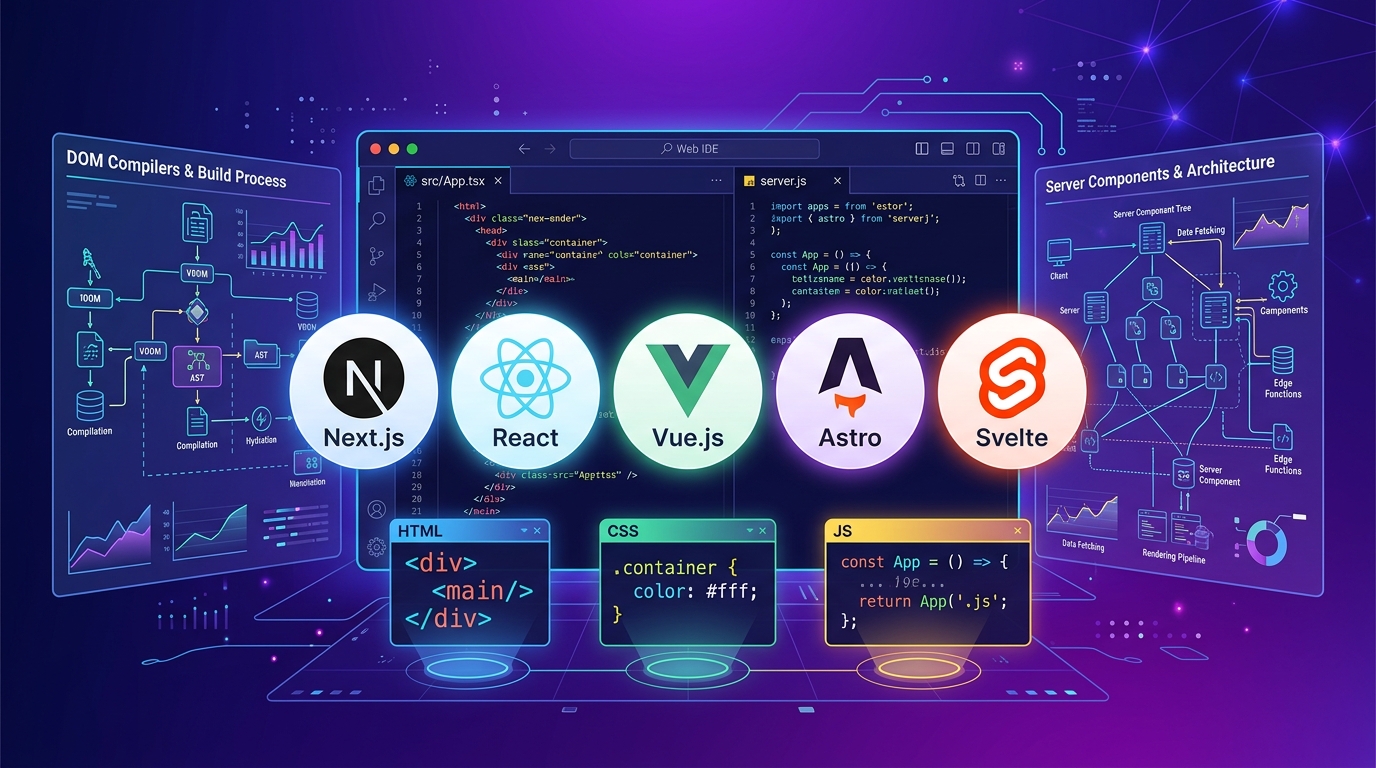
As of July 2026, the core technologies dominating modern SaaS web applications, blog/marketing static websites, ultra-fast e-commerce, and large-scale frontend systems are Web Frameworks & UI Meta-Frameworks. Moving beyond simple DOM manipulation, full-stack React Server Components (RSC), Islands architecture, and compiler-based reactivity directly determine development productivity.
As of July 2026, the key selection criteria for web frameworks center on “SSR vs SSG vs SPA vs Islands architecture rendering structures, full-stack Server Components (RSC) support, Search Engine Optimization (SEO) and Core Web Vitals scores, ultra-lightweight bundle sizes, and developer job market ecosystems” as core success metrics for frontend architecture.
The five major frameworks leading today’s modern web ecosystem—Next.js (Next.js 15), React (React 19), Vue.js (Vue 3.5 / Nuxt 3), Astro (Astro 5), and Svelte (Svelte / SvelteKit 5)—are innovating web development with their own distinct architectures.
Based on the latest data from July 30, 2026, and real-world web frontend benchmarks, this guide provides an in-depth comparison of these 5 major web frameworks—covering rendering specifications (SSR/SSG/SPA/Islands), SEO performance, bundle sizes, reactivity engines, developer ecosystems, and optimal framework choices by project goal with comprehensive, detailed analysis.
1. Executive Summary: 2026 Top 5 Web Frameworks at a Glance
For busy frontend developers and tech leads, here is a comprehensive comparison table summarizing the core specifications and key features of the 5 major frameworks as of July 2026.
📊 July 2026 Top 5 Web Frameworks Comparison Table
| Feature | Next.js (Next.js 15) | React (React 19) | Vue (Vue.js) | Astro (Astro 5) | Svelte (Svelte 5) |
|---|---|---|---|---|---|
| Core Philosophy | Full-Stack React Meta-Framework Standard | UI Component Rendering Library | Intuitive Single File Components (SFC) | Zero-JS Islands #1 Content SEO | Virtual DOM-Free Lightweight Compiler |
| Rendering Architecture | Full-Stack (SSR/SSG/ISR/PPR) | Client-Side SPA (Requires Meta Tools) | SPA / Full-Stack (Nuxt 3) | Islands Architecture (Zero-JS) | No-Virtual-DOM Compiler (Runes) |
| SEO Performance & CWV | Top Tier (#1 in Server-Side Rendering) | Moderate (Needs SPA SSR workarounds) | High (Top tier when combined with Nuxt SSR) | Top Tier (#1 100-point Lighthouse Score) | Top Tier (Ultra-lightweight rendering) |
| JS Bundle Size | Medium ~ Large (Includes React runtime) | Medium (Includes React runtime) | Small ~ Medium (Includes Vue runtime) | Top Tier (Hydrates only required parts) | Top Tier (0% Runtime overhead) |
| Learning Curve | Steep (App Router & RSC concepts) | Moderate (JSX & React Hooks) | Gentle (Intuitive SFC HTML/CSS/JS) | Gentle (#1 HTML syntax-friendly) | Moderate (Runes compiler reactivity) |
| Jobs & Ecosystem | Top Tier (#1 Global Frontend Market) | Top Tier (#1 Largest Global Community) | High (Top tier in Asian enterprise) | High (Blogs, docs, portfolios) | Moderate (High developer satisfaction) |
| Best Recommended For | Large-scale full-stack SaaS, modern e-commerce | Component-based libraries, SPAs | Rapid utility development, web services | Blogs, marketing, SEO-first sites | Ultra-fast responsive web, lightweight bundle apps |
2. Deep Dive into Core Features of the 5 Web Frameworks
The optimal framework is determined by the nature of the web application you are building—whether it’s a full-stack React SaaS, global component UI, intuitive web app, SEO-focused static marketing blog, or virtual DOM-free ultra-lightweight reactive app.
🖤 1) Next.js (Next.js 15) - #1 Full-Stack React Meta-Framework
- App Router & Server Components (RSC): Flexibly combines server data rendering and client rendering to deliver SEO, security, and fast initial page loads simultaneously.
- Server Actions: Direct execution of server-side functions for handling data forms without requiring separate API routes.
⚛️ 2) React (React 19) - #1 World’s Largest UI Library Ecosystem
- React Compiler & Hooks: Combined with millions of open-source UI libraries (Radix, Shadcn UI, MUI) and a compiler, maintaining the #1 position in global frontend job markets.
🟢 3) Vue.js (Vue 3.5 / Nuxt 3) - #1 Intuitive Single File Components (SFC)
- Composition API & Nuxt 3: Write HTML, CSS, and JavaScript intuitively inside a single
.vuefile, ensuring a fast learning curve and high development productivity.
🚀 4) Astro (Astro 5) - #1 Zero-JS Islands Architecture & SEO
- Islands Architecture: Renders static HTML by default and injects JavaScript only into dynamic UI components (Islands) requiring interaction, achieving perfect 100-point Lighthouse performance scores. (Currently powering vstipapp!)
- Multi-Framework Integration: Freely mix React, Vue, and Svelte components within a single project.
⚡ 5) Svelte (Svelte / SvelteKit 5) - #1 Virtual DOM-Free Lightweight Compiler
- No Virtual DOM & Runes: Compiles into pure vanilla JS code at build time without a runtime library, resulting in tiny bundle sizes and microsecond-level reactivity.
3. SEO Performance (Lighthouse) and Bundle Size Showdown
[SEO Initial Load Speed & Core Web Vitals Benchmark]
Astro (Astro 5)       : ⭐⭐⭐⭐⭐ (#1 Zero-JS Islands Architecture)
Svelte (SvelteKit 5)  : ⭐⭐⭐⭐⭐ (0% Runtime overhead ultra-lightweight bundle)
Next.js (Next.js 15)  : ⭐⭐⭐⭐☆ (Top-tier SSR server pre-rendering)
Vue / Nuxt 3          : ⭐⭐⭐█☆ (Excellent SEO when combined with Nuxt 3)
React SPA (React 19)  : ⭐⭐⭐☆☆ (Requires client SPA rendering workarounds)
4. Frontend Job Market & Ecosystem Market Share
[Global Job Market & Developer Ecosystem Share]
- React & Next.js       : Approx. 45% ~ 50% (#1 Global job market)
- Vue.js & Nuxt         : Approx. 20% ~ 25% (Asian & European enterprise)
- Svelte / SvelteKit    : Approx. 10% ~ 15% (#1 Developer satisfaction)
- Astro 5               : Approx. 10% ~ 15% (Rapidly growing in content/static sites)
5. Final Recommendation Guide by Developer & Project Goal
Based on the above comparison, here is the final selection guide based on “What kind of web application are you trying to build?”
🎯 1) Large-Scale Interactive Full-Stack SaaS, E-Commerce, Global Services & Job Seekers
- Best Choice: Next.js (Next.js 15)
- Reason: Holds the #1 global market share among developers and boasts the strongest App Router Server Component ecosystem.
🎯 2) Teams Looking to Reuse Rich React UI Component Libraries (Shadcn UI, etc.)
- Best Choice: React (React 19)
- Reason: Ranks #1 among the 5 tools for npm package community reusability across millions of projects.
🎯 3) Developers Familiar with HTML/CSS/JS Seeking an Intuitive Frontend Solution Quickly
- Best Choice: Vue.js (Vue 3.5)
- Reason: Offers an intuitive Single File Component (SFC) syntax with a gentle learning curve.
🎯 4) Sites Where SEO and Page Load Speed Are Priority #1 (Blogs, Marketing Sites, Tech Docs, Portfolios)
- Best Choice: Astro (Astro 5)
- Reason: Delivers top-tier Lighthouse 100-point performance and superior SEO via Zero-JS Islands architecture.
🎯 5) Developers Who Want Zero Virtual DOM Overhead & Ultra-Lightweight, Blazing-Fast Reactive Apps
- Best Choice: Svelte (Svelte / SvelteKit 5)
- Reason: Guarantees compiler-based 0% runtime overhead and peak developer satisfaction.
6. Conclusion: Building Your Web Framework Selection Pipeline
The ultimate takeaway for web frameworks in July 2026 is “Adopt a smart multi-framework architecture: build main content-driven websites requiring strong SEO with Astro 5, and design large-scale, complex full-stack web applications with Next.js 15.”
Choose the web framework that perfectly fits your development team’s tech stack and service goals to deliver the ultimate user experience! 🚀✨