Wireless Earbuds Comparison 2026: AirPods Pro 3 vs Galaxy Buds4 Pro vs Sony WF-1000XM6 vs Bose QC Ultra vs Sennheiser MTW4 — The Complete Guide
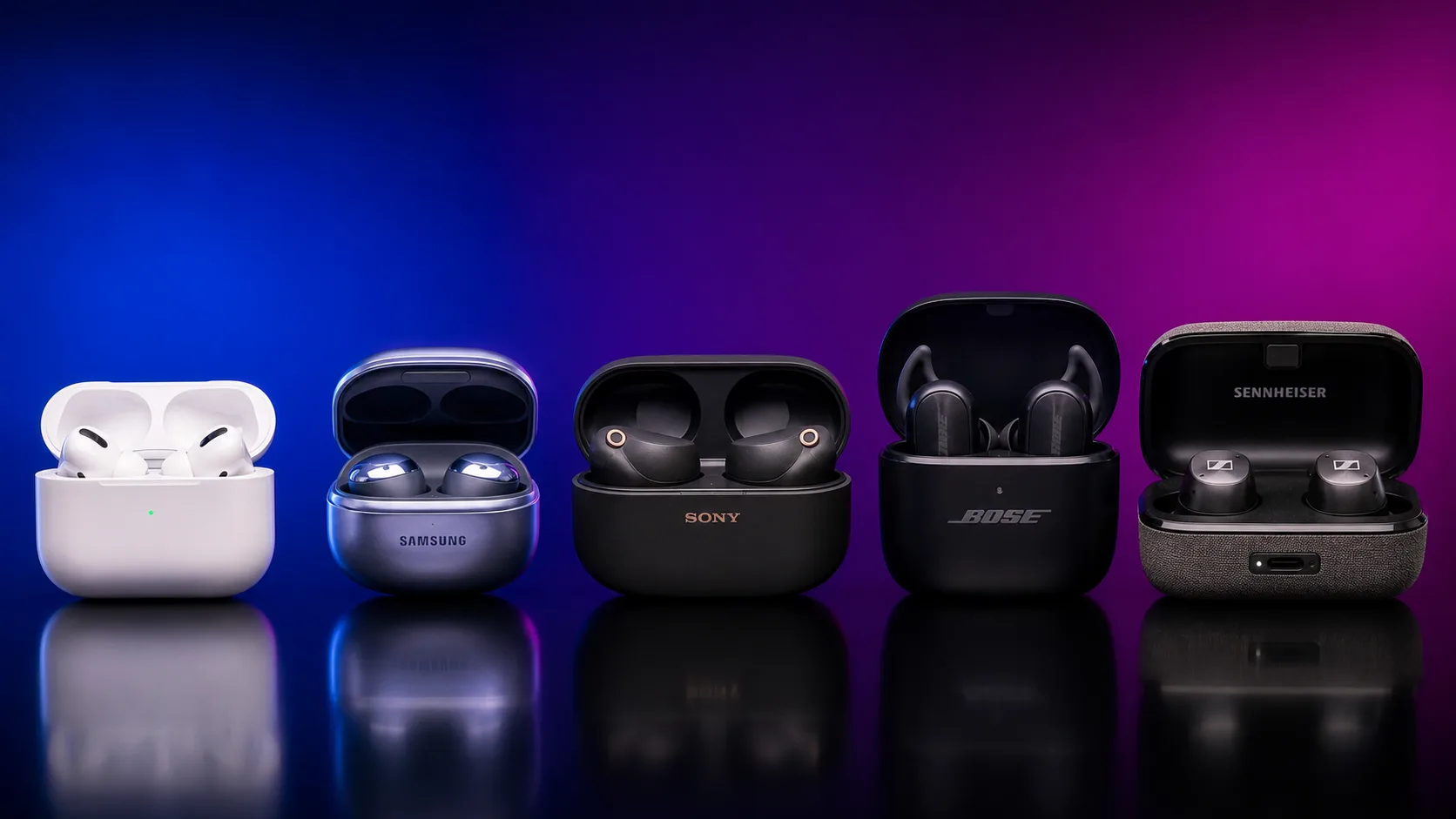
As of August 2026, the premium wireless earbuds market — spanning the high ₩300,000s (roughly $260) all the way up to nearly ₩500,000 (about $360) — is going through one of its busiest generational shake-ups in years. Samsung unveiled the Galaxy Buds4 Pro at its February Galaxy Unpacked event, and Sony launched the WF-1000XM6 that same month, so two brands replaced their flagships within a single half-year. Apple’s AirPods Pro 3, unveiled last fall, is still holding down the top of Apple’s lineup. This wireless earbuds comparison isn’t just a spec-sheet dump — it cross-checks the four axes that actually drive a real purchase decision (battery, ANC, codecs, and price) against official specs and published pricing.
This has also been a year of unusual cost pressure across the electronics industry, driven by a spike in memory-chip prices, and Apple did in fact raise Mac and iPad prices on June 25, 2026. But AirPods were left out of that round of hikes, along with the iPhone and Apple Watch, so the Korean retail price of the AirPods Pro 3 hasn’t moved — a sign that Apple is choosing to defend earbuds pricing specifically even while absorbing cost pressure elsewhere. Sony went the opposite direction: the WF-1000XM6 launched roughly ₩140,000 (about $100) above its predecessor’s Korean price, putting it near the top of the premium-earbuds price range in practice. Same market, same moment, and yet every brand is running a completely different pricing playbook.
For buyers, the decision really comes down to three axes. The first is raw noise-cancelling (ANC) performance, where Sony and Bose are the traditional heavyweights, though AirPods Pro 3 is marketing itself as “the best ANC we’ve ever made.” The second is ecosystem lock-in: iPhone owners get a dramatically better experience out of AirPods, and Galaxy owners out of Buds, especially for things like real-time interpretation. The third is codecs and sound quality — if you want hi-res audio on Android, Sony’s LDAC or Samsung’s SSC-UHQ has the edge, while AirPods is capped at AAC, which is a hard ceiling on lossless playback no matter what you’re streaming from. This piece works through all three axes across the five products from a real-world buying perspective.
If you spend a lot of time streaming music through your earbuds, our YouTube Music vs Spotify: music streaming service comparison is worth reading alongside this one — it makes the codec discussion below much more concrete.
1. Executive Summary: The 2026 Wireless Earbuds Comparison at a Glance
For readers short on time, here’s every core spec for all five flagship earbuds compressed into one table.
📊 Wireless Earbuds Comparison — Full Spec Table
| Category | AirPods Pro 3 | Galaxy Buds4 Pro | Sony WF-1000XM6 | Bose QC Ultra (2nd Gen) | Sennheiser MTW4 |
|---|---|---|---|---|---|
| Core design philosophy | Deep iPhone ecosystem integration | Galaxy AI integration (translation, One UI) | Best-in-class ANC and call quality | Immersive Audio and personalized hearing tuning | Codec versatility, hi-fi focus |
| Latest generation launch | September 2025 | March 2026 (Korean launch) | February 2026 | 2025 (2nd gen) | February 2024 |
| Official Korean price | ₩369,000 (~$265) | ₩359,000 (~$258) | ₩499,000 (~$359) | ₩359,000 (~$258) | ₩419,000 (~$301, launch price) |
| Official US price | ~$249 reported (unconfirmed) | $249.99 | $329.99 | $299 (sale price around $249) | $299.95 |
| Bluetooth | 5.3 | 6.1 (LE Audio) | 5.3 | 5.3 | 5.4 |
| Top-tier codec | AAC/SBC only (no LDAC or aptX) | SSC-UHQ, 24-bit/96kHz (Galaxy-only) | LDAC, up to 990kbps | Codec not disclosed (unconfirmed) | aptX Lossless / Adaptive |
| Earbud-only battery (ANC on) | 8 hours | 6 hours | 8 hours | 4 hours (Immersive Audio on) | 7 hours |
| Total battery with case | 24 hours | 26 hours | 16 hours | Not disclosed (3 extra charges via case) | 30 hours |
| Water resistance rating | IP57 | IP57 | IPX4 | IPX4 | IP54 |
| Pros | iPhone integration, new heart-rate sensor and hearing-aid features | Real-time translation, Galaxy AI integration | Powerful ANC, strong call quality, LDAC hi-fi | Immersive Audio, automatic hearing calibration | Widest codec support, longest battery life |
| Cons | No lossless audio playback | Shortest earbud-only battery life in the lineup | No battery gains, highest price | Codec info undisclosed, short battery life | Successor (MTW5) may land soon |
| Best for | Heavy iPhone users | Heavy Galaxy users, frequent international travelers | Buyers who won’t compromise on ANC or call quality | Buyers who prioritize immersive playback | Android hi-fi enthusiasts |
The row that deserves the closest look is codecs and battery. Lumping all five products together under one “noise-cancelling earbuds” label makes it easy to draw the wrong conclusion. AirPods Pro 3 supports AAC only, so no matter how good your lossless source file is, it gets compressed the moment it reaches the earbud — while the Galaxy Buds4 Pro’s SSC-UHQ is a conditional spec that only activates when paired with a Galaxy device. Getting a wireless earbuds comparison right means not missing these “conditional specs.”
2. Deep Dive: The Five Flagship Wireless Earbuds
🍎 1) AirPods Pro 3 (Apple) — The Finished Product of the iPhone Ecosystem
- Unveiled September 2025, no successor rumors yet: Announced at Apple’s September 2025 event as the third-generation follow-up to the AirPods Pro 2, there’s still no confirmed fourth-generation launch or rumor as of August 2026. It remains the newest earbud in Apple’s entire lineup.
- A genuinely new feature set: heart-rate sensing and hearing-aid function: An LED-based heart-rate sensor — a first for this generation — now lets you track fitness metrics without an Apple Watch. Combined with the new Hearing Aid feature and live translation, several reviews in the first half of 2026 have called this “Apple’s biggest earbuds feature leap since 2019.”
- Apple claims “best ANC ever,” but reviewers are split: Apple says noise cancellation is 2x better than the Pro 2 and 4x better than the original AirPods Pro. Third-party reviews, though, tend to land on “excellent, but not necessarily the industry’s best” — so calling it a clear win over Sony or Bose would be premature.
- AAC/SBC only — a fundamental ceiling: Bluetooth 5.3 and IP57 dust/water resistance are both solid, but there’s no LDAC or aptX support of any kind. That means no matter how good a lossless streaming subscription you’re paying for, the AirPods Pro 3 recompresses everything down to AAC before it hits your ears.
- Battery and charging: Up to 8 hours earbud-only with ANC on (10 hours with ANC off, 7.5 hours with Spatial Audio on), 24 hours total with the case, and support for MagSafe, Qi wireless, and USB-C charging.
- Price held steady, exempt from June’s hike: When Apple announced its across-the-board price increases in June 2026, AirPods were explicitly excluded, so the Korean retail price of ₩369,000 (~$265) hasn’t budged. The US list price is reportedly unchanged from the prior generation at around $249, though we weren’t able to directly re-verify that figure on Apple’s official US pricing page during this review.
📱 2) Galaxy Buds4 Pro (Samsung) — The Cutting Edge of Galaxy AI Interpretation
- The newest product released in the first half of 2026: Unveiled at Samsung’s Galaxy Unpacked event on February 25, 2026, with official Korean retail launch on March 6. That’s roughly two years after the previous flagship, the Buds3 Pro (2024), and it makes the Buds4 Pro the most recently released of all five products in this comparison.
- Real-time interpretation is the headline differentiator: Built on Samsung’s Bixby-powered real-time interpretation feature, it plays back a live Korean translation when someone speaks a foreign language to you, and works in reverse as well. The catch is that this feature only activates on devices running One UI 6.1.1 or later with Galaxy AI support.
- A 2-way speaker setup with a conditional hi-fi codec: The buds use a 2-way driver setup — an 11mm dynamic woofer paired with a 5.5mm planar tweeter — and support Samsung’s Seamless Codec (SSC) UHQ mode, capable of streaming up to 24-bit/96kHz. That high-res mode only kicks in when paired with a Galaxy device on One UI 6.1.1 or later; on anything else, it falls back to SBC/AAC.
- Battery life trails the pack on earbud-only playback: With Adaptive ANC 2.0 on, you get up to 6 hours earbud-only (26 hours total with the case); with ANC off, up to 7 hours (30 hours total). The dual-driver design is a clear trade-off — earbud-only playback lags the competition here.
- Bluetooth 6.1 and call quality: The Buds4 Pro run Bluetooth 6.1 with LE Audio support, and multiple reviews have called the call-mic quality “best in class” after this generation’s improvements. It also carries an IP57 dust/water rating.
- Price: Official Korean launch price is ₩359,000 (~$258) via Samsung’s official Korean online store (Samsung.com), while the US price is $249.99, with Amazon listings dipping into the low $230s as of April 2026.
🎧 3) Sony WF-1000XM6 — The Peak of ANC and Call Quality
- A new 2026 launch — at a higher price: Unveiled February 12, 2026, with retail sales starting February 23. As the successor to the 2023 XM5, reports confirm the Korean price rose by roughly ₩140,000 (about $100) over its predecessor — putting it near the top of the price range among the premium earbuds compared here.
- Eight mics per earbud for stronger ANC: A new QN3e chip paired with eight microphones per earbud (up from the previous generation) drives improved ANC performance. The driver itself is 8.4mm.
- LDAC up to 990kbps — the benchmark for Android hi-fi: The XM6 supports SBC/AAC/LDAC/LC3 (no aptX family), with LDAC streaming up to 990kbps — roughly triple standard Bluetooth bandwidth — for genuinely high-res playback.
- Multipoint and LDAC can’t run together — a real trade-off: The XM6 supports connecting two devices simultaneously (multipoint), but turning that on automatically disables LDAC’s high-res mode and drops you to AAC/SBC. In practice, that means you can’t keep a laptop and phone both connected for work while also holding onto LDAC’s top sound quality.
- Battery is essentially unchanged: 8 hours with ANC on, 16 hours total with the case — identical to the previous-generation XM5. ANC and codec support both improved, but battery life stayed flat, which is worth weighing.
- A major upgrade to call quality: Three voice-dedicated MEMS mics per earbud plus AI beamforming meaningfully improve call quality. It carries an IPX4 water-resistance rating, Bluetooth 5.3, and is priced at ₩499,000 (~$359) in Korea, $329.99 in the US, and €299.99 in Europe.
🔇 4) Bose QuietComfort Ultra Earbuds, 2nd Gen — The Immersive-Audio Powerhouse
- Still Bose’s current flagship as of August 2026: This second-generation model launched in 2025, and as of August 2026 there’s no confirmed third-generation model or refresh announcement. Of the five products here, it has the slowest refresh cycle.
- Immersive Audio is the headline feature, but it comes at a real battery cost: With Immersive Audio turned on, you get up to 4 hours earbud-only — the shortest earbud-only runtime of any product in this comparison. With it off, that rises to 6 hours. The case adds up to 3 additional full charges.
- CustomTune auto-calibrates hearing and fit: CustomTune automatically analyzes your ear shape and hearing profile the moment you put the earbuds in and tunes the sound accordingly, while ActiveSense adaptive ANC adjusts noise-cancelling strength on the fly based on your environment.
- Codec support is officially undocumented: Bose’s official product page doesn’t specify whether LDAC or aptX are supported, and we weren’t able to definitively confirm the codec list during this review. If codec support matters to you in a wireless earbuds comparison, it’s worth double-checking the latest official specs directly before buying.
- Call quality and new features: SpeechClarity technology and AI-based background-noise suppression were both strengthened in this second generation, alongside newly added wireless charging-case support (a first for this line) and a Cinema Mode spatial-audio setting for video content.
- Price and connectivity: ₩359,000 (~$258) at Bose’s official Korean store (around ₩367,890 / ~$265 at Danawa, Korea’s popular price-comparison shopping site, at its lowest listed price), with a US official price of $299 (frequently discounted down to $249). It runs Bluetooth 5.3, supports multipoint, has a roughly 9m (30 ft) range, and carries an IPX4 water-resistance rating.
🎼 5) Sennheiser MOMENTUM True Wireless 4 (MTW4) — Champion of Codec Variety
- A 2024 release that’s still Sennheiser’s newest as of August 2026: Launched in February 2024, the MTW4 remains, as of this writing, Sennheiser’s most recent officially released true-wireless earbud. Its successor, the MTW5, cleared FCC certification in April 2026 and leaked images have surfaced, fueling “launch imminent” rumors — but no official release has been confirmed as of August 3, 2026. Worth noting separately: Sennheiser’s over-ear “Momentum 5 Wireless” headphones launched in June 2026, but that’s a headphone, not an earbud, so don’t confuse the two.
- The widest codec support of all five products: Built on Qualcomm’s S5 Sound Gen 2 platform (Snapdragon Sound), the MTW4 supports aptX Lossless, aptX Adaptive, LE Audio (LC3), and Auracast. It skips LDAC and Samsung’s SSC, but on raw Android hi-fi codec variety, nothing else in this comparison comes close.
- Best-in-class battery, at 30 hours total with the case: 7.5 hours with ANC off / 7 hours with ANC on, earbud-only, and 30 hours total with the case — the longest runtime of any product here. It uses a 7mm dynamic driver with a TrueResponse wideband transducer.
- IP54 uses a different rating scheme: The MTW4 carries an IP54 rating (dust ingress level 5, water level 4), which uses a different notation than the IP57/IPX4 ratings on the other products, so a straight numeric comparison can be misleading. Think of it as splash-resistant, everyday-use protection.
- The successor risk is real: There’s no hardware change to point to yet, but with the MTW5 already through FCC certification and rumored to drop the in-ear stabilizer wings entirely as part of a form-factor redesign, buying the MTW4 today means buying right before a generational turnover.
- Price: The official Korean launch price was ₩419,000 (~$301, as of its 2024 launch), and we weren’t able to re-confirm a current August 2026 street price during this review. In the US it’s $299.95, and in Canada $429.95 CAD.
3. The Big Three Benchmark: ANC, Codecs, and Battery Life
The single most-searched question in any wireless earbuds comparison is “okay, but which one’s actually best?” Rather than force an overall ranking, it’s much clearer to break the answer down axis by axis.
[Core-axis ratings as of August 2026]
Absolute ANC performance : AirPods Pro 3 ⭐⭐⭐⭐⭐(self-claimed) / Sony XM6 ⭐⭐⭐⭐⭐ / Bose QCU2 ⭐⭐⭐⭐☆
Codec versatility        : Sennheiser MTW4 ⭐⭐⭐⭐⭐ / Sony XM6 ⭐⭐⭐⭐☆ / Buds4 Pro ⭐⭐⭐☆☆(conditional) / AirPods ⭐⭐☆☆☆
Battery with case : Sennheiser MTW4 ⭐⭐⭐⭐⭐(30h) / Buds4 Pro ⭐⭐⭐⭐☆(26h) / AirPods ⭐⭐⭐⭐☆(24h) / Sony ⭐⭐☆☆☆(16h)| Category | AirPods Pro 3 | Buds4 Pro | Sony XM6 | Bose QCU2 | Sennheiser MTW4 |
|---|---|---|---|---|---|
| Earbud-only (ANC on) | 8 hours | 6 hours | 8 hours | 4 hours (Immersive Audio on) | 7 hours |
| Total with case | 24 hours | 26 hours | 16 hours | Not disclosed (3 extra charges) | 30 hours |
| Top-tier codec | AAC only | SSC-UHQ (conditional) | LDAC 990kbps | Unconfirmed | aptX Lossless |
| Water resistance | IP57 | IP57 | IPX4 | IPX4 | IP54 |
Apple’s “best ANC ever” claim needs an asterisk — third-party reviews still rank Sony’s XM6 and Bose’s QCU2 among the traditional leaders, so this axis genuinely comes down to mixed opinions. Battery, on the other hand, splits cleanly along hard numbers. Sony’s WF-1000XM6 traded battery gains for a big jump in ANC and call quality, and ended up stuck at the same 16-hour total (with case) as its predecessor — which is barely half of the Sennheiser MTW4’s 30-hour total. If you wear earbuds essentially all day, this battery gap is probably the single most noticeable difference in daily use.
Codec support shows the starkest contrast of all. The Sennheiser MTW4 dominates on sheer variety with aptX Lossless, aptX Adaptive, LE Audio, and Auracast, while Sony’s XM6 with LDAC at up to 990kbps functions as the de facto benchmark for Android hi-fi. The Galaxy Buds4 Pro’s SSC-UHQ (24-bit/96kHz) looks great on paper, but don’t lose sight of the fact that it’s a “conditional spec” — it only works with a Galaxy device on One UI 6.1.1 or later. AirPods Pro 3, meanwhile, is stuck with AAC/SBC only and is clearly the weakest performer on this axis — the price it pays for its tight iPhone-ecosystem integration.
4. Full Price Comparison — What the Wireless Earbuds Comparison Actually Costs
[Official Korean prices — lowest to highest]
Galaxy Buds4 Pro         : ₩359,000 (~$258)
Bose QC Ultra 2nd Gen    : ₩359,000 (~$258)
AirPods Pro 3            : ₩369,000 (~$265)
Sennheiser MTW4          : ₩419,000 (~$301, 2024 launch price — verify current price)
Sony WF-1000XM6          : ₩499,000 (~$359, the highest of the five)
💰 Detailed Price Comparison
| Product | Official Korean price | Official US price | Discounted/sale price examples | Notes |
|---|---|---|---|---|
| AirPods Pro 3 | ₩369,000 (~$265) | ~$249 reported (unconfirmed) | — | Excluded from Apple’s June 2026 price hike |
| Galaxy Buds4 Pro | ₩359,000 (~$258) | $249.99 | Low $230s on Amazon (April 2026) | The newest launch of the first half of 2026 |
| Sony WF-1000XM6 | ₩499,000 (~$359) | $329.99 | — | Up roughly ₩140,000 (~$100) over its predecessor in Korea |
| Bose QC Ultra 2nd Gen | ₩359,000 (~$258) | $299 | Down to $249 on Amazon and elsewhere (frequently) | Around ₩367,890 (~$265) lowest listed at Danawa |
| Sennheiser MTW4 | ₩419,000 (~$301, launch price) | $299.95 | CAD $429.95 in Canada | August 2026 street price unconfirmed |
At a glance, the Galaxy Buds4 Pro and Bose QC Ultra 2nd Gen look like the cheapest options at ₩359,000, but there are three more things worth factoring in before calling that the whole story. First, the Sony WF-1000XM6 jumped roughly ₩140,000 (~$100) in Korea this generation, pushing it near the top of the price range. That premium buys you stronger ANC and call quality, but with battery life unchanged from the previous model, it’s a tougher sell on pure value. Second, the Sennheiser MTW4’s ₩419,000 price reflects its 2024 launch price, so the real-time lowest price on sites like Danawa as of August 2026 is very likely discounted below that — definitely check current pricing before you buy. Third, both Bose and Sony frequently show US sale prices roughly $50 below list, so if you’re considering an international/direct import purchase, budgeting off the list price alone would be a mistake.
One more thing worth calling out is Apple’s pricing strategy specifically. The first half of 2026 saw real cost pressure across consumer electronics from a spike in memory-chip prices, and Apple did raise Mac and iPad prices in June — but AirPods were left out of that increase. That reads as a deliberate choice to protect price competitiveness specifically in the earbuds line, and in practice, the ₩369,000 AirPods Pro 3 price stays close enough to the ₩359,000 Galaxy Buds4 Pro and Bose QCU2 that it’s still defensible.
5. Final Recommendations by Use Case
In the end, the right answer in any wireless earbuds comparison comes down to “which ecosystem are you already in, and what do you actually use earbuds for.” Here are six buyer personas to help narrow it down.
🎯 1) Heavy iPhone, Mac, and Apple Watch users
- Best pick: AirPods Pro 3
- Why: Automatic device switching, spatial audio, and the newly added heart-rate sensor and hearing-aid features add up to a level of ecosystem integration nothing else here can match. There’s a real codec ceiling, but for day-to-day convenience, this is hard to replace.
🎯 2) Galaxy phone owners who travel abroad or converse in other languages often
- Best pick: Galaxy Buds4 Pro
- Why: The Bixby-powered real-time interpretation feature, paired with a One UI 6.1.1+ Galaxy AI device, delivers genuinely useful help abroad. Just keep in mind the earbud-only battery life is a shorter 6 hours, so you’ll need to reach for the case more often on long days out.
🎯 3) Anyone who refuses to compromise on ANC or call quality
- Best pick: Sony WF-1000XM6
- Why: Eight microphones per earbud and AI beamforming deliver noticeably better calls, and LDAC hi-fi support means neither sound quality nor calls are compromised. The trade-offs are the ₩499,000 (~$359) price tag — the highest here — and battery life that hasn’t budged.
🎯 4) Buyers who prioritize immersive video/music playback and personalized hearing calibration
- Best pick: Bose QuietComfort Ultra Earbuds, 2nd Gen
- Why: CustomTune’s automatic hearing calibration and Cinema Mode spatial audio meaningfully deepen content immersion. Just factor in the trade-off that Immersive Audio drops earbud-only battery life to 4 hours when it’s switched on.
🎯 5) Android users who want hi-fi sound and the broadest possible codec compatibility
- Best pick: Sennheiser MTW4
- Why: From aptX Lossless to LE Audio and Auracast, this is the widest codec support of the five, and at 30 hours total with the case, it also has the most generous battery life. The one thing to know going in is that a successor (MTW5) may not be far off.
🎯 6) Budget-first buyers who still want solid all-around quality
- Best pick: Galaxy Buds4 Pro or Bose QC Ultra 2nd Gen (₩359,000 / ~$258)
- Why: These are the two cheapest options of the five, and each still brings a clear standout strength — Galaxy AI integration on one side, Immersive Audio on the other — making them the easiest picks to justify on value alone.
6. Practical Tips and Common Mistakes
✅ Tip 1) Remember the Galaxy Buds4 Pro’s SSC-UHQ is a “conditional spec”
It’s an easy trap: buy for the 24-bit/96kHz number, then pair it with an iPhone or an older Android phone and end up stuck on SBC/AAC the whole time. SSC-UHQ only activates when paired with a Galaxy device running One UI 6.1.1 or later, so check your phone’s OS version before you buy if hi-fi sound is the point.
✅ Tip 2) Turning on multipoint on the Sony WF-1000XM6 turns off LDAC
Enabling multipoint to connect a laptop and phone at the same time automatically switches LDAC’s high-res mode down to AAC/SBC. In practice, that means you can’t have a perfect video-call setup and top-quality music playback running simultaneously while working from home — you’ll need to get in the habit of toggling multipoint on and off depending on what you’re doing.
✅ Tip 3) Plan out your Immersive Audio usage on the Bose QC Ultra 2nd Gen ahead of time
Turning Immersive Audio on drops earbud-only battery life to 4 hours. On long days out, it’s more practical to leave it off by default and only switch it on during dedicated content-watching sessions rather than running it constantly.
✅ Tip 4) Check the latest MTW5 news before buying the Sennheiser MTW4
The MTW4’s successor, the MTW5, cleared FCC certification in April 2026, and a form-factor redesign (dropping the stabilizer wings) has already been rumored. There’s no official launch announcement yet, but depending on when you buy, you could be picking up a soon-to-be-outdated model — worth a quick search for the latest news alongside current pricing before you decide.
✅ Tip 5) Don’t expect the AirPods Pro 3 to deliver true lossless sound
Even if you’re streaming lossless or hi-res tracks through Apple Music or another service, the AirPods Pro 3 only supports AAC/SBC, so everything gets recompressed at the earbud. If hi-fi sound quality is your top priority, Sony or Sennheiser is the fundamentally better choice.
✅ Tip 6) Watch out — water-resistance ratings aren’t labeled the same way across products
IP57 (AirPods Pro 3, Galaxy Buds4 Pro), IPX4 (Sony XM6, Bose QCU2), and IP54 (Sennheiser MTW4) use different rating scales entirely. Don’t just compare the digits — check each product’s actual description against how you’ll really use it (sweat during workouts, rain during outdoor activities, and so on).
7. Frequently Asked Questions (FAQ)
Q. What should I check first in a wireless earbuds comparison as of August 2026?
Start with your phone ecosystem (iPhone or Galaxy) and your top priority (ANC, codec support, battery life, or call quality). Nailing down just those two narrows the five products here down to one or two realistic candidates. If you’re a Galaxy user chasing hi-fi sound, also double-check the conditions for SSC-UHQ to actually activate.
Q. Which is better, AirPods Pro 3 or Galaxy Buds4 Pro?
There’s no universal answer — it depends entirely on your ecosystem. iPhone users get a massive edge from AirPods Pro 3’s automatic device switching and spatial audio, while Galaxy users get an equally big edge from the Buds4 Pro’s real-time interpretation and Galaxy AI integration. On raw hardware specs alone, water resistance is tied (both IP57), but battery life favors the AirPods Pro 3 (8 hours) over the Buds4 Pro (6 hours).
Q. How much better is the Sony WF-1000XM6 than the previous XM5?
ANC improved thanks to eight microphones per earbud and the new QN3e chip, and call quality got a substantial boost from three voice-dedicated mics plus AI beamforming. Battery life, though (8 hours with ANC on, 16 hours total with the case), is completely unchanged from the XM5, and the Korean price rose roughly ₩140,000 (~$100).
Q. What exactly does the Bose QC Ultra Earbuds 2nd Gen support in terms of codecs?
Unfortunately, Bose’s official page doesn’t specify whether LDAC or aptX are supported, and we weren’t able to pin down a definitive answer during this review. If hi-fi codec support is a dealbreaker for you, it’s worth contacting Bose directly or checking the latest reviews before buying.
Q. The Sennheiser MTW5 is supposedly coming soon — is it still okay to buy the MTW4 now?
FCC certification in April 2026 and leaked images have fueled “launch imminent” rumors, but there’s still no official release announcement as of August 3, 2026. If you need earbuds right now, the MTW4 is still competitive on codec variety and battery life — but if you can wait a few months, holding out for the official MTW5 announcement is a reasonable call too.
Q. How much do water-resistance ratings (IP57, IPX4, IP54) actually differ in a wireless earbuds comparison?
IP57 means dust-ingress level 5 (limited dust intrusion) and water level 7 (withstands submersion to a set depth); IPX4 has no dust rating and covers splashing water from any direction; IP54 combines dust level 5 with water level 4 (splash protection from any direction). Higher numbers are generally better, but for day-to-day scenarios like workout sweat or a sudden rain shower, all three ratings hold up fine in practice.
Q. Does the Galaxy Buds4 Pro’s real-time interpretation feature work on any device?
No. It only activates when paired with a Galaxy AI-supported device running One UI 6.1.1 or later. It won’t fully work on older Galaxy phones or Android phones from other manufacturers, so if interpretation is your main reason for buying, check your phone’s One UI version first.
Q. Which of the five products has the longest battery life?
By total battery including the case, the Sennheiser MTW4 leads at 30 hours, followed by the Galaxy Buds4 Pro (26 hours) and AirPods Pro 3 (24 hours), with the Sony WF-1000XM6 trailing at 16 hours. Looking at earbud-only playback alone, AirPods Pro 3 and Sony XM6 tie for first at 8 hours.
8. Conclusion: The Practical Verdict on 2026’s Wireless Earbuds
As of August 2026, this wireless earbuds comparison ultimately comes down to ecosystem and priorities. Apple has held the AirPods Pro 3’s price steady, doubling down on iPhone ecosystem lock-in, while Samsung has pulled out real-time interpretation as its clear differentiator with the Galaxy Buds4 Pro. Sony pushed ANC and call quality further and raised its price sharply to match, Bose continues defending its own turf with Immersive Audio, and Sennheiser is holding onto Android hi-fi users with the broadest codec support and the longest battery life around.
The practical takeaway is straightforward. iPhone users should look first at the AirPods Pro 3, and Galaxy users at the Buds4 Pro — that’s the natural starting point. If you’re not tied to an ecosystem and just want the best raw performance, Sony’s WF-1000XM6 leads on ANC and call quality, Sennheiser’s MTW4 leads on codec variety and battery life, and Bose’s QC Ultra 2nd Gen leads on content immersion. Just remember the Sennheiser’s risk of an imminent MTW5 launch, and Sony’s flat battery life, before you commit. If you also watch a lot of video content through your earbuds, our Netflix vs TVING: streaming service comparison (TVING is a major Korean streaming platform) is worth a look, and if call or voice-chat quality is on your mind, so is our KakaoTalk vs Telegram: messenger app comparison (KakaoTalk is South Korea’s dominant messaging app).
[Summary: the right pick for your situation]

Heavy iPhone / Mac / Apple Watch user
  → AirPods Pro 3 (₩369,000 / ~$265 — heart-rate sensor, hearing aid, live translation)

Galaxy user + frequent travel or foreign-language conversations
  → Galaxy Buds4 Pro (₩359,000 / ~$258 — real-time interpretation, needs One UI 6.1.1+)

Zero compromise on ANC and call quality
  → Sony WF-1000XM6 (₩499,000 / ~$359 — LDAC hi-fi, but 16-hour battery)

Video/music immersion + personalized hearing calibration
  → Bose QC Ultra 2nd Gen (₩359,000 / ~$258 — 4-hour battery with Immersive Audio on)

Android hi-fi + codec variety + longest battery life
  → Sennheiser MTW4 (₩419,000 / ~$301 launch price — check MTW5 launch risk)

Budget first + solid all-around quality
  → Galaxy Buds4 Pro or Bose QC Ultra 2nd Gen (₩359,000 / ~$258)
The real answer in any wireless earbuds comparison isn’t picking whatever tops the spec sheet — it’s matching a product to your own phone ecosystem and daily habits. Use the tables and benchmarks above to set your priorities first, and always double-check the latest official pricing right before you buy.