LG OLED vs Samsung Neo QLED vs Sony Bravia vs TCL vs Hisense: The Complete 2026 TV Comparison
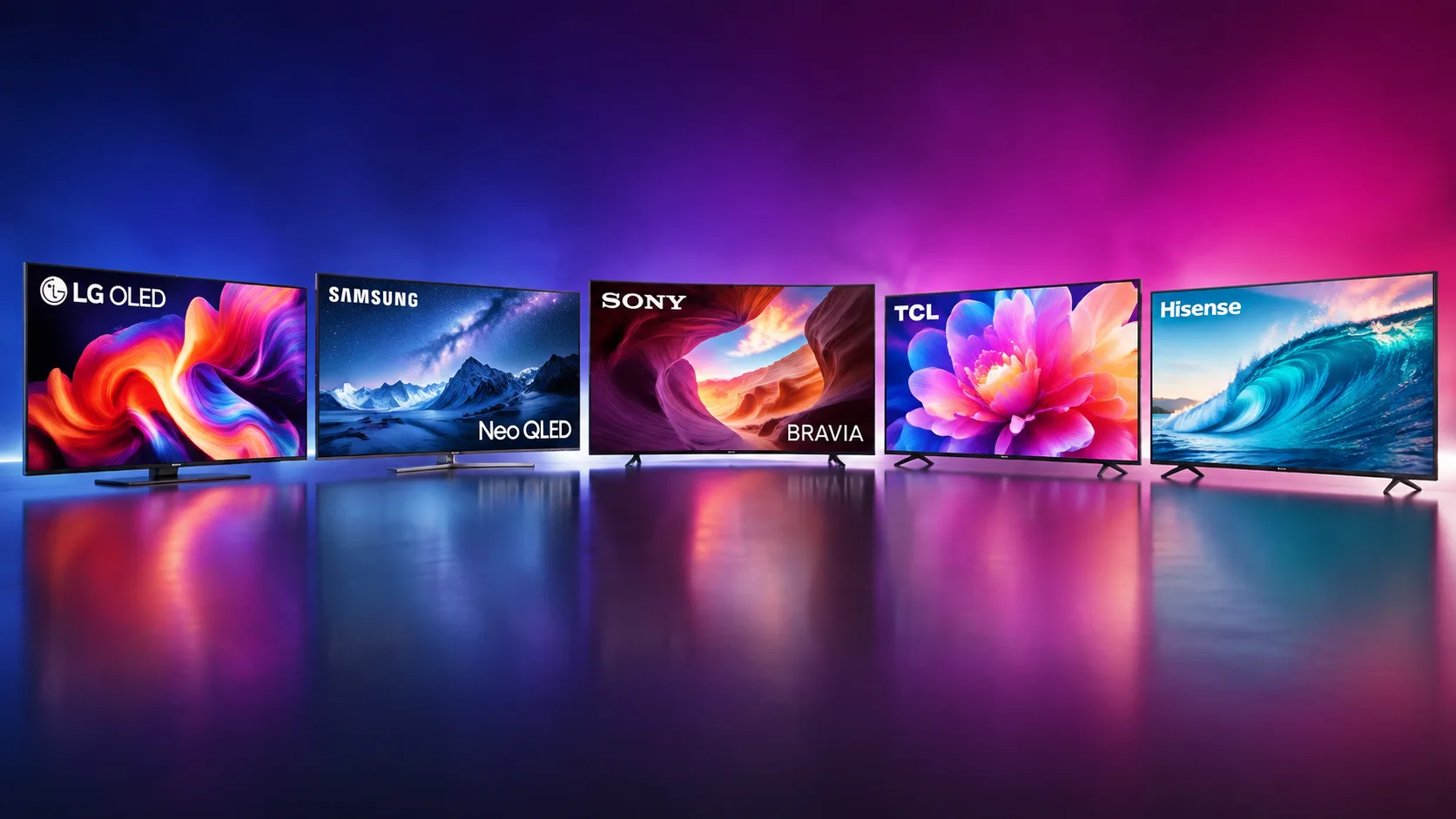
If you’re shopping for a new TV in August 2026, you’ll quickly notice that this is an unusually confusing moment to be doing it. Demand for AI-server memory has exploded, and the price of the DRAM and other memory chips that go into TVs has jumped nearly tenfold from second-half-2025 levels — a shock that’s flowing straight through to retail price tags. Samsung Electronics posted a loss in its consumer electronics, TV, and mobile businesses in Q2 2026, while LG Electronics’ TV division stayed profitable for a second straight quarter. When two companies eating the same cost shock come out with opposite results, skipping a proper TV comparison can cost you hundreds of dollars — or worse.
This guide puts the 2026 lineups from all five major brands — LG OLED evo, Samsung Neo QLED/OLED, Sony Bravia, TCL QD-Mini LED, and Hisense ULED — head to head on panel technology, brightness, gaming specs, and verified real-world pricing. We’re starting with the single most time-sensitive fact you’ll read today: TCL Korea raised prices on its entire lineup, TVs included, by roughly 5% starting August 1, 2026. If you’re reading this in early August, that timing alone could affect your budget.
Choosing a TV panel type — OLED vs. Mini LED — is one of the rare appliance decisions that completely reshapes your entire viewing experience. Someone who watches movies in a pitch-dark room and someone who leaves the curtains open and watches TV in a sunlit living room can end up with opposite “right answers.” This guide covers a full comparison table, brand-by-brand deep dives, brightness and picture-quality benchmarks, a complete pricing breakdown, recommendations by use case, practical buying tips, and an FAQ — and wherever a figure couldn’t be verified, we’ve labeled it “unconfirmed” rather than guessing, so you get an honest basis for your decision.
1. Executive Summary: The 2026 TV Landscape at a Glance
For readers short on time, here’s the essential 2026 lineup info from all five brands compressed into one table.
📊 Complete Comparison of the Top 5 TVs (August 2026)
| Category | LG OLED evo | Samsung Neo QLED / OLED | Sony Bravia | TCL QD-Mini LED | Hisense ULED |
|---|---|---|---|---|---|
| Core design philosophy | Perfect black levels and contrast for dark-room home theater | Ultra-high-brightness Mini LED plus a parallel QD-OLED track | RGB LEDs individually controlled — a middle ground between OLED and Mini LED | Aggressive value, leading the race on peak brightness numbers | Sweet spot of performance per dollar, with region-specific OS |
| 2026 flagship models | OLED evo G6 / C6 / C6H | Neo QLED QNH80·QNH70, OLED SH95·SH90·SH85, Micro RGB RH95 | BRAVIA 9 II, BRAVIA 7 II | QM9K (flagship), QM8K (upper-mid) | U6·U6 Pro, U7, UR9 (RGB Mini LED), U8QG |
| Panel type | WOLED (OLED evo) | Neo QLED (Mini LED) / QD-OLED | True RGB Mini LED (individually controlled RGB LEDs) | QD-Mini LED | ULED Mini LED / RGB Mini LED (UR9) |
| Processor | 3rd-gen Alpha 11 AI processor (NPU up 5.6x) | NQ4 AI Gen2 / Micro RGB AI Engine Pro | Cognitive Processor XR | — | — |
| Smart OS | webOS 26 | Tizen | Google TV | Google TV (with Gemini AI) | Google TV (North America) / VIDAA (Europe) |
| Confirmed flagship pricing | C6 65” ₩3.79M ( | QNH80 100” ₩9.59M ( | 9 II 65” from $3,600 (US) | QM9K 65” $1,499 (US), QM8K 65” | U7 from $1,299, UR9 65” $3,498 (US) |
| Peak brightness (highlight) | ~3.9x the prior generation (G6, third-party estimate up to 4,500 nits) | 2,150–2,300 nits for reference, based on prior-gen S95F | ~4,250 nits measured (10% window) | Over 6,000 nits (manufacturer claim) | U8QG ~3,300 nits |
| Strengths | Perfect blacks, wide viewing angles, reflections cut roughly in half | Optimized for bright rooms, no burn-in risk | 2x color volume via RGB control, Sony’s signature picture tuning | Dominant brightness and value, 6,000-zone local dimming | Native 165Hz, strong value-gaming option |
| Weaknesses | Full-screen brightness relatively lower, premium pricing | No Dolby Vision (HDR10+ only); most 2026 specs still unpublished | Notably premium pricing vs. rivals; official South Korean launch unconfirmed | August price hike, top-tier Korean pricing unconfirmed | Comparatively low brand recognition in Korea; official South Korean launch unconfirmed |
| Best for | Dark-room home theater fans wanting cinema-grade contrast | Bright-living-room buyers who want a large screen with no burn-in worries | Buyers who want premium picture quality and sound with no compromises | Value shoppers who want maximum specs within a budget | Value-focused gamers sensitive to spec-per-dollar |
The row most worth lingering on here is “peak brightness.” Looking at the raw numbers alone, TCL appears to blow everyone else away — but that figure is a manufacturer claim with no disclosed testing conditions. Sony’s Bravia 9 II, by contrast, hit 4,250 nits under third-party measurement (CE-Sphere), which carries very different credibility. This is exactly why a TV comparison should never come down to a single number.
2. Deep Dive: The Five TV Lineups
🟢 1) LG OLED evo — The undisputed champion of dark rooms, now spanning 42”–97”
- Restructured into a three-tier G6/C6/C6H lineup: The flagship OLED evo G6 comes in five sizes (55/65/77/83/97”), while the mainstream C6 spans six sizes (42/48/55/65/77/83”). New for 2026, the C6H is a special edition — available only in 77” and 83” within the C6 lineup — that carries the same “Hyper Radiant Color” panel as the G6, signaling a strategic shift toward putting flagship panels at upper-mid-tier prices.
- 3rd-generation Alpha 11 AI processor: NPU performance is up 5.6x and GPU performance up 70% over the prior chip, with a new dual-AI-engine system. This processor won a Tom’s Guide AI Award 2026, recognized for its upscaling and picture-correction performance.
- Reflections cut roughly in half: A new “Reflection Free Premium” coating cuts glare to roughly half of the previous model’s level — a noticeable upgrade if you watch TV in a daylit living room.
- The C6, surprisingly, is the more gaming-forward set: The entire C6 lineup (42”–83”) supports 4K 165Hz VRR, while the G6 debuted “the world’s first 4K 120Hz cloud gaming” support at CES 2026.
- A price-freeze strategy: LG says it held 2026 launch pricing “largely in line” with 2025. In Korea, list prices run ₩3.79 million (
$2,750) for the C6 65”, ₩8.7 million ($6,300) for the G6 77”, and ₩13 million (~$9,420) for the G6 83”. In the US, pricing starts at $2,499 for the G6 55” and $1,399 for the C6 42”.
🔵 2) Samsung Neo QLED / OLED — The brightness king with a new naming scheme
- Skipping “G” and jumping straight to “H”: Where the 2025 lineup was the “F” generation (QN90F, S95F), 2026 skips “G” entirely and moves to the “H” generation. Confusingly, Samsung’s Korean domestic model names don’t match the US QN90H/S95H format — instead they use Korea-only designations like QNH80·QNH70 (Neo QLED) and SH95·SH90·SH85 (OLED), with the “H” tucked in the middle. It’s an easy detail to trip over when cross-referencing global model names.
- A two-track lineup: Neo QLED spans two series — QNH80 and QNH70 — across seven sizes (43”–100”), while OLED spans three series — SH95, SH90, and SH85 — across six sizes (42”–83”). Above both sits the standalone Micro RGB RH95, the only line to carry the new “Micro RGB AI Engine Pro” processor.
- Only partial pricing confirmed: Per press releases, confirmed prices include the Neo QLED QNH80 100” at ₩9.59 million (
$6,950), the OLED SH95 77” at ₩7.19 million ($5,210), and the QNH80 55” at ₩1.89 million (~$1,370). Accurate Korean pricing for the remaining sizes and series wasn’t available at the time of this research. - Estimating performance from the prior generation: The 2025 QN90F supported up to 165Hz VRR gaming (144Hz on the 115” model), a Glare Free matte display, and Dolby Atmos-linked Object Tracking Sound+. Its OLED sibling, the S95F, hit roughly 2,150–2,300 nits of HDR brightness on its QD-OLED panel. The exact nit ratings, panel zone counts, and new processor names for the 2026 QNH80 and SH95 weren’t listed on official spec pages as of this writing.
- OLED is closing the gap fast: A June 2026 report noted Samsung’s OLED TVs are rapidly narrowing LG’s OLED market-share lead, with the gap now down to just 6 percentage points — a notable shift in the competitive landscape within the OLED segment specifically.
🟣 3) Sony Bravia — A third path built on RGB backlighting
- New True RGB backlight technology: Where conventional Mini LED uses white LEDs filtered through colored lenses, the Bravia 9 II and 7 II switch to True RGB, individually controlling red, green, and blue LEDs directly. Sony claims 2x the color volume of its predecessor (the original Bravia 9), and the industry has taken to calling this “a third path between OLED and Mini LED.”
- Officially unveiled around May 27–28, 2026: The flagship BRAVIA 9 II (ranging roughly 55”–115”, with some source discrepancy) and the upper-mid BRAVIA 7 II (50”–98”, with sources split on whether the smallest size is 50” or 55”) launched together, alongside the BRAVIA Theater Trio soundbar system.
- Cognitive Processor XR remains the core: This chip handles upscaling, motion processing, HDR tone mapping, and local dimming in an integrated pipeline — the backbone of Sony’s signature picture tuning. On the audio side, the 9 II ships with a 2.2.2-channel up-firing speaker array supporting Dolby Atmos and DTS:X.
- Brightness verified by independent testing: Third-party lab CE-Sphere measured roughly 4,250 nits in a 10% HDR window, with sustained full-screen brightness around 910 nits. Under real HDR content, sustained brightness of 2,500–3,000 nits was confirmed.
- Pricing confirmed for the US only: The BRAVIA 9 II runs from $3,600 (65”) up to $31,000 (115”), and the BRAVIA 7 II from $1,599.99 (50”) up to $8,999.99 (98”) — the 65” model runs $2,599.99. Whether the sets have an official South Korean launch — and at what price — wasn’t confirmed as of this research. If you’re shopping specifically in the Korean market, treat Sony’s newest Bravia sets as a US/import consideration rather than a locally stocked option for now.
🔴 4) TCL QD-Mini LED — Shaking up the market on raw brightness numbers, at the top of the value tier
- A full lineup refresh with QM9K and QM8K: As of April 2026, the entire prior lineup was discontinued in favor of new models. The flagship is the QM9K, with the upper-mid QM8K below it.
- A “6,000+ nit” manufacturer claim: Peak brightness is listed as “over 6,000 nits” — a manufacturer figure with no disclosed testing methodology. Local dimming tops out at LD6000 (6,000 individually controlled zones), with a native 144Hz refresh rate. The sets support HDR10, HDR10+, Dolby Vision IQ, and HLG, plus two HDMI 2.1 ports.
- Google TV plus Gemini AI: The smart OS is Google TV, integrated with Google’s Gemini voice assistant. Audio is a relatively modest 2.1-channel setup.
- US pricing: QM9K runs $1,499 (65”), $1,999 (75”), $2,499 (85”), and $3,499 (98”). There’s also mention of the 75” being adjusted to $2,499 afterward, suggesting some gap between initial launch pricing and street pricing at retail. In Korea, confirmed QM8K pricing is roughly ₩1.99 million (
$1,440) for 65” and ₩2.39 million ($1,730) for 75”; exact Korean pricing for the QM9K wasn’t available. - A 5% price increase starting August 1: Citing cost pressure from the memory super-cycle, TCL Korea announced roughly 5% price increases across TVs, refrigerators, and washing machines effective August 1, 2026 (units were still available at the old price through July 31). If you’re reading this in August, this directly affects the budget you should be planning around.
🟡 5) Hisense ULED — A dark horse with a region-by-region strategy
- A four-tier lineup: The entry-volume U6/U6 Pro, the performance line U7 (which Hisense positions itself as “the sweet spot of performance for the price”), and the premium RGB Mini LED UR9. A gaming-focused U8QG (native 165Hz, ~3,300 nits HDR) was also confirmed separately, though it’s unclear whether it’s an entirely new 2026 model or a successor to a previous generation.
- The U8QG’s gaming specs stand out: Third-party reviews have measured a native 165Hz panel with anti-glare treatment, roughly 3,300 nits of HDR brightness, and roughly 9ms of input lag in game mode. Reviewers have specifically called out that this is a native 165Hz panel, unlike competing sets that market “AI-interpolated 165Hz.”
- Pricing is only clearly confirmed in the US: The U7 series starts at $1,299, and the UR9 runs $3,498 (65”), $4,998 (75”), $5,998 (85”), and $8,998 (100”). Specific pricing for the U6 and U6 Pro hasn’t been published yet. An official South Korean launch and Korean pricing weren’t confirmed — Hisense’s brand recognition in Korea is comparatively low, so shoppers there should treat these sets primarily as an import/overseas option rather than a set they can walk into a local store and buy.
- Different smart OS by region: North America runs Google TV, while Europe runs Hisense’s own VIDAA OS in parallel. VIDAA notably leans harder into broadcast-related features than competing OSes, including USB-based tuner recording.
- Rumors of an LG tie-up: In May 2026, reports surfaced that LG Electronics and Hisense had discussed a TV-business joint venture or sale. LG officially denied the reports, while Hisense’s position on the matter wasn’t confirmed.
3. Brightness and Picture Quality Benchmarks
Brightness numbers are where TV comparisons most often go wrong. Because highlight brightness and sustained full-screen brightness differ so dramatically by panel type, ranking sets by a single number can leave you with a completely different experience than you expected.
[Brightness by panel type — highlight vs. sustained full-screen]
Mini LED (TCL, Samsung, Hisense)    : ⭐⭐⭐⭐⭐ 1,500–6,000+ nits, full-screen 800–1,200 nits
RGB Mini LED (Sony, Hisense UR9)    : ⭐⭐⭐⭐☆ 4,000–4,250 nits (measured), strong color volume
OLED (LG, Samsung) : ⭐⭐⭐☆☆ Highlight up to ~4,500 nits, full-screen only 150–250 nits| Category | OLED (LG, Samsung) | Mini LED (Samsung, TCL, Hisense) | RGB Mini LED (Sony, Hisense UR9) |
|---|---|---|---|
| Peak highlight brightness | ~1,000–4,500 nits (wide variance by model) | 1,500–6,000+ nits (TCL QM9K claims over 6,000, unverified) | 4,000–4,250 nits (Sony Bravia 9 II, measured) |
| Sustained full-screen brightness | 150–250 nits | 800–1,200 nits | ~910 nits (Bravia 9 II, measured) |
| Burn-in risk | Present (though sharply reduced on the newest panels) | Essentially none | Essentially none |
| Max refresh rate | LG G6/C6: 165Hz VRR; Samsung SH95: 165Hz (based on prior generation) | TCL QM9K: 144Hz native; Hisense U7/U8QG: 165Hz native | Sony’s exact Hz rating unconfirmed |
| Game-mode input lag | Not confirmed by brand | Hisense U7: ~9ms (third-party measured) | Unconfirmed |
The takeaway from this table is straightforward. Mini LED — TCL in particular — wins the highlight-brightness race, while OLED still holds the edge in sustained full-screen brightness, viewing angle, and contrast. If you frequently watch movies in a dark room, OLED’s perfect blacks will define your perceived picture quality. If you leave the curtains open and watch sports or variety shows in a sunlit living room, Mini LED’s sustained full-screen brightness is far more practical.
Price-per-inch is also worth a glance. Simply dividing confirmed prices by screen size, the LG C6 65” (₩3.79M / $2,750) works out to roughly ₩58,000 ($42) per inch; the Samsung SH95 77” (₩7.19M / $5,210) to roughly ₩93,000 ($67); the LG G6 77” (₩8.7M / $6,300) to roughly ₩113,000 ($82); the TCL QM8K 65” (₩1.99M / ₩2.39M / $1,440) to roughly ₩31,000 ($22); and the 75” ($1,730) to roughly ₩32,000 ($23). Keep in mind this is a crude division across different series and generations that ignores panel-grade and brightness differences, so it’s safer to read it as a qualitative signal — “Chinese-brand sets run roughly 30–40% cheaper than Samsung’s premium Mini LED” — rather than a precise metric.
4. Complete Pricing Comparison
You can’t talk about 2026 TV pricing without the memory-chip super-cycle as backdrop. Reports indicate that surging demand for AI-server memory has pushed DRAM and other TV-grade memory prices up nearly tenfold from second-half-2025 levels, and the fallout has been direct: Samsung Electronics posted a loss in its consumer electronics, TV, and mobile businesses in Q2 2026. LG Electronics’ TV business, by contrast, stayed profitable for a second straight quarter thanks to differences in its cost structure and revenue model. Industry watchers expect 2026 TV prices broadly to face upward pressure of at least 3%.
[Confirmed flagship pricing by brand, as of August 2026]
LG OLED evo    : C6 65" ₩3.79M(~$2,750) / G6 77" ₩8.7M(~$6,300) / G6 83" ₩13M(~$9,420) (Korea)
Samsung Neo QLED : QNH80 55" ₩1.89M(~$1,370) / QNH80 100" ₩9.59M(~$6,950) (Korea, partial data only)
Samsung OLED   : SH95 77" ₩7.19M(~$5,210) (Korea)
Sony Bravia    : 9 II 65" from $3,600 ~ 115" $31,000 (US; Korea pricing unconfirmed)
TCL            : QM9K 65" $1,499 (US) / QM8K 65" ~₩1.99M(~$1,440) (Korea) → +5% starting 8/1
Hisense        : U7 from $1,299 / UR9 65" $3,498 (US; Korea pricing unconfirmed)
💰 Detailed Price Comparison by Brand
| Brand | Confirmed flagship pricing | Currency / market | Notes |
|---|---|---|---|
| LG OLED evo | C6 65” ₩3.79M ( | KRW / Korea | Held “largely in line” with 2025 pricing |
| LG OLED evo (US) | G6 55” from $2,499, C6 42” from $1,399 | USD / US | 5 sizes (G6), 6 sizes (C6) |
| Samsung Neo QLED | QNH80 100” ₩9.59M ( | KRW / Korea | Remaining sizes/series unconfirmed |
| Samsung OLED | SH95 77” ₩7.19M (~$5,210) | KRW / Korea | SH90/SH85 pricing unconfirmed |
| Sony Bravia 9 II | 65” $3,600 ~ 115” $31,000 | USD / US | South Korean launch/pricing unconfirmed |
| Sony Bravia 7 II | $1,599.99 (50”) ~ $8,999.99 (98”) | USD / US | 65” model is $2,599.99 |
| TCL QM9K | 65” $1,499, 75” $1,999, 85” $2,499, 98” $3,499 | USD / US | Korea-wide ~5% price hike starting August |
| TCL QM8K | 65” | KRW / Korea | QM9K Korean pricing unconfirmed |
| Hisense U7 | From $1,299 | USD / US | South Korean launch unconfirmed |
| Hisense UR9 | 65” $3,498, 75” $4,998, 85” $5,998, 100” $8,998 | USD / US | South Korean launch unconfirmed |
Three things stand out from a real-cost perspective. First, TCL’s August 1 price hike is one of the few cases where the increase rate (about 5%) was clearly disclosed. Units were available at the old price through July 31, so if you’re reading this in August, you’re likely already looking at the increased price. Second, South Korean pricing for most of Samsung’s, Sony’s, and Hisense’s 2026 lineups simply hasn’t been published. Only a handful of models and sizes mentioned in press releases could be confirmed, so you should always recheck live pricing on the official store right before buying. Third, even under the same memory-cost pressure, brands are responding differently. LG chose to freeze pricing while TCL chose to raise it — a split that likely reflects differences in cost structure and market positioning (premium vs. value).
5. Final Recommendations by Use Case
The last step in any TV comparison always comes down to “what fits my actual viewing environment.” Here’s a breakdown across six common scenarios.
🎯 1) You close the curtains and watch movies/home theater in a dark room
- Best pick: LG OLED evo (C6 or G6)
- Why: Perfect blacks and wide viewing angles are still OLED’s exclusive territory. The Reflection Free coating, which cuts glare roughly in half, keeps contrast intact even in rooms with some ambient light left on.
🎯 2) You watch TV in a bright living room with the curtains open, even during the day
- Best pick: Samsung Neo QLED or TCL QM9K
- Why: Sustained full-screen brightness in the 800–1,200-nit range is far higher than OLED, so the picture doesn’t wash out in daylight. No burn-in worries also makes these a better fit for long viewing sessions.
🎯 3) You’re a frequent console or PC gamer
- Best pick: LG OLED evo C6 or Hisense U8QG
- Why: The C6’s entire lineup (42”–83”) supports 4K 165Hz VRR, giving you a wide range of screen sizes to choose from, while the Hisense U8QG offers native 165Hz with roughly 9ms of input lag as a strong value-gaming pick. The LG G6 also supports the world’s first 4K 120Hz cloud gaming, which is a real draw if you stream games.
🎯 4) Your budget is limited but you want the biggest screen and highest specs you can get
- Best pick: TCL QM8K or QM9K
- Why: You get brightness and local-dimming specs comparable to Samsung’s premium Mini LED sets at roughly 30–40% lower prices. Just make sure you check whether the August price hike has already been applied, and confirm the QM9K’s exact Korean street price directly before buying.
🎯 5) You want premium picture quality and sound with zero compromises
- Best pick: Sony Bravia 9 II
- Why: Individually controlled RGB LEDs deliver a claimed 2x color volume over the predecessor, paired with 2.2.2-channel up-firing sound for a set that nails both picture and audio at once. That said, an official South Korean launch hasn’t been confirmed, so if you’re shopping locally, check with Sony Korea’s official channels first.
🎯 6) Price-per-spec sensitivity matters most, and so does after-sales support and distribution
- Best pick: Samsung Neo QLED or LG OLED evo
- Why: Both brands have by far the strongest domestic distribution and service infrastructure. Since it’s unclear whether some of Hisense’s and Sony’s newest models even have an official South Korean launch, Samsung and LG are the safer picks if local purchase, installation, and after-sales support matter to you.
6. Practical Buying Tips and Common Mistakes
✅ Tip 1) Don’t rank TVs by the “nits” number alone
TCL’s “over 6,000 nits” is a manufacturer claim with no disclosed testing conditions. Sony’s Bravia 9 II, on the other hand, hit 4,250 nits under CE-Sphere’s independent measurement. Even though both figures use the same unit, a comparison becomes meaningless when the source and testing methodology differ this much — so look for third-party measured data whenever you can find it.
✅ Tip 2) If you’re buying a TCL in early August, check for pre-hike stock
TCL Korea raised prices on its entire lineup, TVs included, by roughly 5% starting August 1, 2026. If you’re shopping after the hike took effect, it’s worth checking with stores or online retailers directly to see whether they still have inventory tagged at the old price.
✅ Tip 3) Price-per-inch is a rough guide, not a hard rule
Calculations like “the LG C6 65” costs about ₩58,000 ($42) per inch” or “the TCL QM8K 65” costs about ₩31,000 ($22) per inch” are simple division that ignores panel grade, brightness, and refresh-rate differences. This method is really only valid when comparing sizes within the same brand and series — keep that in mind before using it to compare across brands.
✅ Tip 4) Always verify models with uncertain South Korean availability before you commit
The Sony Bravia 9 II and 7 II, and the Hisense U6, U7, and UR9, all had unconfirmed South Korean launch status and pricing as of this research. If you’re considering importing one from overseas, carefully check voltage compatibility, after-sales service, and firmware update support before buying.
✅ Tip 5) OLED burn-in is less of a worry than it used to be, but it hasn’t disappeared
The newest OLED panels reportedly carry sharply reduced burn-in risk, but that’s still not the same as Mini LED’s “essentially none.” If your usage pattern involves leaving a static broadcast logo or fixed UI element on screen for long stretches, Mini LED remains the safer choice.
✅ Tip 6) Factor the smart OS into your buying decision too
LG runs webOS 26, Samsung runs Tizen, Sony and TCL run Google TV (TCL with Gemini AI built in), and Hisense splits between Google TV and VIDAA by region. Checking which OTT apps you regularly use are supported — and how well the OS fits your phone’s ecosystem — can make a real difference in day-to-day satisfaction. If you’re also thinking about what you’ll actually watch on your new TV, our streaming service comparison breaks down Netflix, TVING, Coupang Play, Wavve, and Disney+ side by side.
7. Frequently Asked Questions (FAQ)
Q. When comparing TVs, should I decide between OLED and Mini LED first?
Your viewing environment is the most important factor to settle first. If you mostly watch with the curtains closed in a dark room, OLED’s perfect blacks and wide viewing angles win out. If you watch in a bright living room even during the day, Mini LED’s much higher sustained full-screen brightness (800–1,200 nits) will feel noticeably better in practice. Decide between those two axes first, then work through budget and gaming specs.
Q. Why are 2026 TV prices climbing so much?
Because surging demand for AI-server memory has pushed DRAM and other TV-grade memory prices up nearly tenfold from second-half-2025 levels. This memory super-cycle is why Samsung Electronics posted a loss in its consumer electronics, TV, and mobile businesses in Q2 2026, and why industry watchers expect 2026 TV prices broadly to face upward pressure of at least 3%.
Q. TCL is raising prices starting in August — until when could I buy at the old price?
TCL Korea kept the old pricing through July 31, 2026, then raised prices on TVs, refrigerators, and washing machines by roughly 5% starting August 1. If you’re reading this now, you’re likely already seeing the increased price, so it’s worth checking with individual retailers about remaining old-price stock.
Q. Which is brighter — Samsung Neo QLED or LG OLED?
On highlight brightness, Mini LED sets like Samsung’s Neo QLED generally run brighter than OLED. That said, exact nit figures for the 2026 Samsung Neo QLED (QNH80) haven’t been officially published; going by the prior-generation QN90F/S95F specs, Mini LED clearly holds the lead in sustained full-screen brightness. LG’s OLED evo G6 was announced as roughly 3.9x brighter than its predecessor, but an exact official nit rating hasn’t been confirmed either.
Q. Can I buy the Sony Bravia 9 II in South Korea?
This research couldn’t confirm an official South Korean launch or local pricing. Most available information centers on the US and Indian markets, so if you’re considering a purchase in Korea, it’s worth contacting Sony Korea’s official channels directly to check.
Q. Can I officially buy Hisense TVs in South Korea?
Hisense has comparatively low brand recognition in Korea, and this research couldn’t confirm an official South Korean launch or local pricing for the U6, U7, or UR9. The only pricing confirmed was in the US market (U7 from $1,299, UR9 65” at $3,498, etc.).
Q. Which TV is best for long gaming sessions without worrying about burn-in?
Mini LED sets — Samsung Neo QLED, TCL QM9K, and Hisense U7/U8QG — carry essentially no burn-in risk, making them comfortable choices even for games with static, long-held UI elements. The Hisense U8QG stands out in particular, with third-party reviews measuring native 165Hz and roughly 9ms of input lag, making it a strong gaming-focused pick.
Q. Is it true that LG and Hisense are merging their TV businesses?
Multiple outlets reported in May 2026 that LG Electronics and China’s Hisense had discussed a joint venture or sale involving their TV businesses. LG Electronics officially denied the reports as “groundless,” and Hisense’s specific position wasn’t confirmed. Still, industry observers read the report itself as a sign of broader concern about the profitability of LG’s TV business.
8. Conclusion: The Practical Takeaway on 2026 TVs
As of August 2026, the conclusion of this TV comparison boils down to: pick your panel type first, then choose a brand within it. If you watch movies in a dark room, LG OLED evo comes closest to the right answer; if you watch TV in a bright living room during the day, Samsung Neo QLED or TCL QM9K are the better fits. That said, the cost increases triggered by the memory super-cycle are landing differently across brands — and TCL’s August 1 price hike, in particular, is something that directly affects your purchase timing.
Sony’s Bravia 9 II is a genuinely interesting middle ground between OLED and Mini LED thanks to its True RGB backlight, but its South Korean launch status is unclear, and Hisense — despite offering strong value-gaming specs — also lacks confirmed official South Korean availability, making it a lower priority if you need to buy locally right now. Weighing in domestic distribution and after-sales support, LG and Samsung remain the safest overall choices, while TCL is a legitimate value pick if budget is your top priority. If you’re also planning what you’ll watch on your new set, check out our music streaming service comparison covering YouTube Music, Spotify, Melon, and Apple Music, and if you’re planning to edit 4K footage shot on a home camera, our video editing software comparison is worth a look too.
[Summary: The right pick for your situation]

Dark-room home theater, movie-focused
  → LG OLED evo (C6 65" from ₩3.79M/~$2,750; G6 for brighter, more premium)

Bright living room, clear picture even in daylight
  → Samsung Neo QLED (QNH80) or TCL QM9K

Gaming-focused (console/PC)
  → LG OLED evo C6 (165Hz VRR across the whole lineup) or Hisense U8QG (value)

Budget-first, large screen for the money
  → TCL QM8K/QM9K (but confirm whether the 8/1 price hike is reflected)

Premium picture + sound, no compromises
  → Sony Bravia 9 II (but confirm South Korean availability first)

Safest choice factoring in local distribution/after-sales support
  → Samsung Neo QLED or LG OLED evo
Settle on your panel type and viewing environment first, then layer in current August pricing — and you can reach a TV comparison conclusion you won’t regret, even in the middle of a memory-super-cycle-driven price shakeup.